
Resources · Medicare
Medicare Advantage vs. Medigap in Florida: How They Differ and Why the First Choice Matters
By Brandon Arkin, elder law attorney, Solkoff Legal, P.A. · Updated November 2026

Medicare Advantage is a private plan that replaces Original Medicare, usually with a provider network and an annual out-of-pocket limit. Medigap supplements Original Medicare so you can use any provider in the U.S. that takes Medicare (Medicare.gov, Choosing a Medigap Policy), but in Florida it's guaranteed regardless of health only in limited windows, so switching back to it later isn't assured (Fla. Stat. 627.6741).
Last checked: CMS hadn't yet published the 2027 Part A and Part B premiums and deductibles. When it does, usually in the fall, replace the 2026 figures on this page. CMS has published the 2027 Part D standard deductible ($700) and out-of-pocket threshold ($2,400) (CMS 2027 Rate Announcement). The annual election period for 2027 coverage ends December 7, 2026 (42 CFR 422.62).
How each one works
With Original Medicare, Medicare pays doctors and hospitals directly, and "you can use any doctor or hospital that takes Medicare, anywhere in the U.S." (Medicare.gov). You pay deductibles and usually 20% coinsurance for Part B services, with no annual cap. A Medigap policy is private insurance that fills some or all of those gaps. Drug coverage comes from a separate Part D plan.
Medicare Advantage (Part C) is a private plan approved by Medicare that takes the place of Parts A and B, often with drug coverage built in. Plans use networks of doctors and hospitals and may require referrals or prior approval. Every plan has a yearly out-of-pocket limit, and once you reach it, the plan pays 100% of covered services for the rest of the year (Medicare.gov, costs).
You can't combine the two. It's illegal to sell you a Medigap policy if you're in a Medicare Advantage plan, unless you're switching back to Original Medicare, and Medigap can't pay Medicare Advantage copays or premiums (Medicare.gov).
Costs and networks
On both paths, you generally keep paying the Part B premium, $202.90 a month in 2026 (CMS). After that, the cost patterns differ:
Medigap: a monthly premium for the policy and another for Part D, then low or predictable costs when you get care. Medicare Advantage: often a low plan premium, then copays and coinsurance as you use care, up to the plan's annual limit.
Networks matter more in Florida than people expect. Many residents split the year between states or want access to a particular cancer center or specialist. A Medicare Advantage network is usually local, and out-of-network care may cost more or not be covered. Original Medicare with Medigap travels with you anywhere in the U.S. Before choosing, check whether your doctors, your hospital and any nursing home you'd use are in a plan's network.
Switching back to Medigap and underwriting in Florida
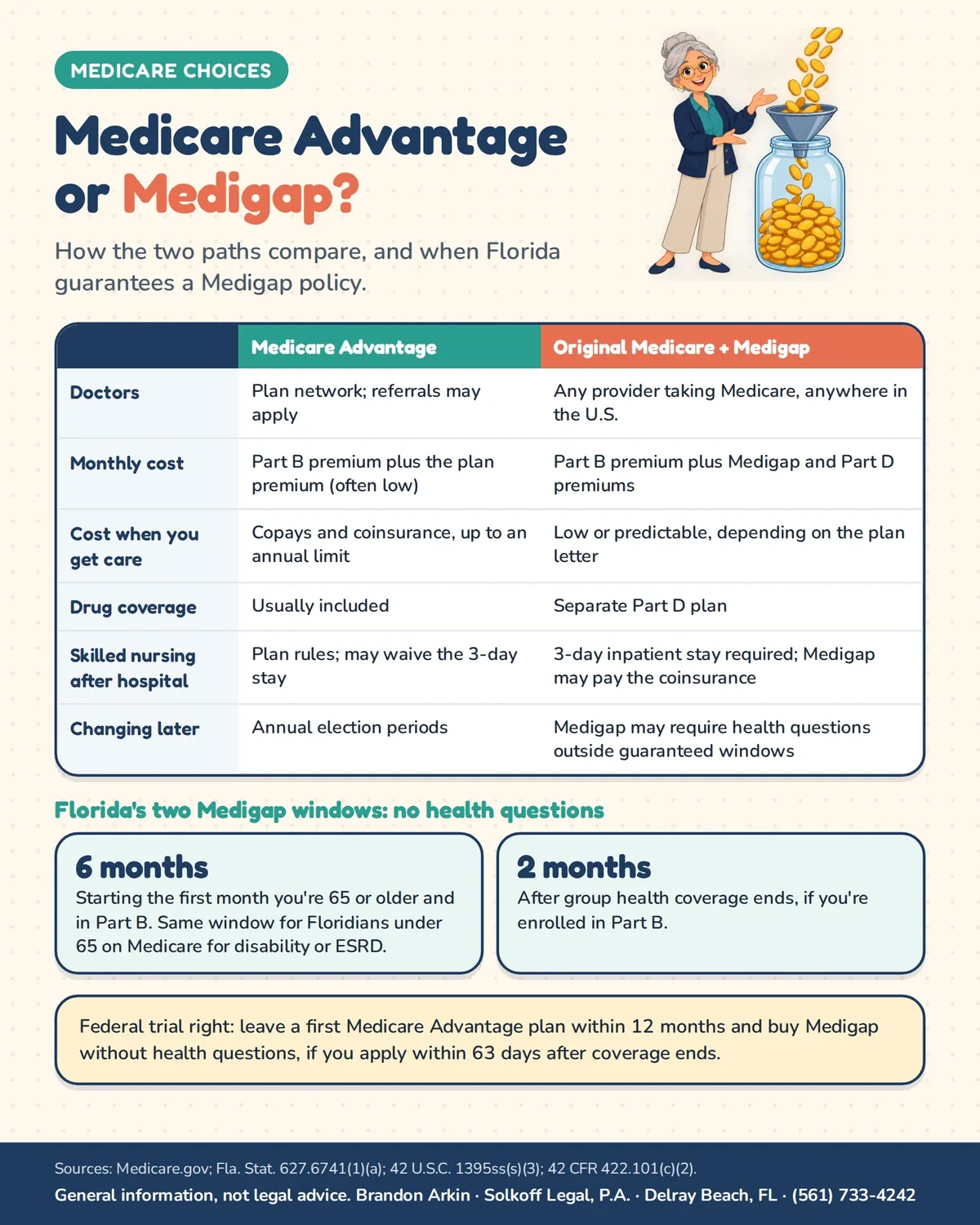
This is the part many families learn too late. Florida law guarantees Medigap enrollment, with no health questions and no higher price for health, in two windows (Fla. Stat. 627.6741(1)(a)):
the 6 months starting with the first month you're 65 or older and enrolled in Part B. Floridians under 65 who are on Medicare because of disability or end-stage renal disease get the same 6-month window; the 2 months after group health coverage ends, if you're enrolled in Part B.
Federal law adds guaranteed-issue rights in specific situations (42 U.S.C. 1395ss(s)(3)), including:
you joined Medicare Advantage when first eligible at 65 and leave within 12 months; you dropped a Medigap policy to join Medicare Advantage for the first time and leave within 12 months. You can get the old policy back if the same insurer still sells it; your plan leaves your area, or you move out of its service area; your Medigap insurer goes bankrupt or misled you.
You generally apply from 60 days before to 63 days after the old coverage ends (Medicare.gov).
Outside these windows, you can leave Medicare Advantage for Original Medicare each year from October 15 to December 7, or from January 1 to March 31 (42 CFR 422.62). But a Medigap insurer can deny you or charge more based on your health (Medicare.gov). Someone who develops a serious illness while in Medicare Advantage may find they can't buy Medigap at all.
Hospital-to-nursing-home stays
Original Medicare covers skilled nursing facility care after a qualifying inpatient hospital stay of 3 days, with coinsurance of $217 a day for days 21 through 100 in 2026 (CMS). Many standard Medigap plans pay that coinsurance (Medicare.gov, compare Medigap plans).
Medicare Advantage plans set their own skilled nursing copays and usually require prior authorization. Federal rules let them cover skilled nursing care without the 3-day stay (42 CFR 422.101(c)(2)). Read the plan's Evidence of Coverage for the details.
Neither path pays for long-term custodial care in a nursing home. When the skilled stay ends, families turn to private pay or Medicaid. Our guides on Medicare non-coverage notices and nursing home admission explain what to do then.
D-SNPs and Medicaid
If you have both Medicare and Medicaid, the choice changes. A Dual Eligible Special Needs Plan (D-SNP) is a type of Medicare Advantage plan for people who also have Medicaid, and it can help coordinate the two programs' benefits (Medicare.gov, special needs plans). Insurers generally can't sell you a Medigap policy if you have Medicaid, and with full Medicaid one is usually unnecessary (Medicare.gov).
Planning points:
After Medicaid approval for nursing home care, review whether a Medigap policy is still worth its premium. If Medicaid pays your Part B premium through a Medicare Savings Program, see our Medicare Savings Programs guide. A D-SNP has to be dropped before joining PACE. See our PACE guide.
A worked example
Hypothetically, Gloria turns 65 in Boynton Beach in March 2027 and enrolls in Part B. She spends summers near her daughter in North Carolina.
If she buys Medigap during her 6-month window, no insurer can refuse her or charge more for her health. She can see doctors in both states. If she instead joins a Medicare Advantage plan at 65, she has 12 months to change her mind and buy any Medigap policy without health questions. If she stays in Medicare Advantage for three years and then develops heart disease, she can still switch to Original Medicare during an election period. But a Florida Medigap insurer could then turn her down.
Neither choice is wrong. What matters is that she understands the trade-off while the window is open.
| Medicare Advantage | Original Medicare + Medigap | |
|---|---|---|
| Doctors | Plan network; referrals may apply | Any provider taking Medicare, anywhere in the U.S. |
| Monthly cost | Part B premium plus the plan premium (often low) | Part B premium plus Medigap and Part D premiums |
| Cost when you get care | Copays and coinsurance, up to an annual limit | Low or predictable, depending on the plan letter |
| Drug coverage | Usually included | Separate Part D plan |
| Skilled nursing after hospital | Plan rules; may waive the 3-day stay | 3-day inpatient stay required; Medigap may pay the coinsurance |
| Prior authorization | Common | Rare under Original Medicare |
| Changing later | Annual election periods | Medigap may require health questions outside guaranteed windows |
Doctors
Medicare Advantage
Plan network; referrals may apply
Original Medicare + Medigap
Any provider taking Medicare, anywhere in the U.S.
Monthly cost
Medicare Advantage
Part B premium plus the plan premium (often low)
Original Medicare + Medigap
Part B premium plus Medigap and Part D premiums
Cost when you get care
Medicare Advantage
Copays and coinsurance, up to an annual limit
Original Medicare + Medigap
Low or predictable, depending on the plan letter
Drug coverage
Medicare Advantage
Usually included
Original Medicare + Medigap
Separate Part D plan
Skilled nursing after hospital
Medicare Advantage
Plan rules; may waive the 3-day stay
Original Medicare + Medigap
3-day inpatient stay required; Medigap may pay the coinsurance
Prior authorization
Medicare Advantage
Common
Original Medicare + Medigap
Rare under Original Medicare
Changing later
Medicare Advantage
Annual election periods
Original Medicare + Medigap
Medigap may require health questions outside guaranteed windows
Your enrollment windows
| Window | Dates | What you can do |
|---|---|---|
| Medigap open enrollment | 6 months from Part B at 65 or older | Buy any Medigap plan sold in Florida, no health questions |
| Annual election period | October 15 – December 7 | Switch Medicare Advantage plans, or move to Original Medicare |
| Medicare Advantage open enrollment | January 1 – March 31 | One change: another Advantage plan, or Original Medicare |
| Federal trial right | Within 12 months of first Advantage enrollment | Return to Medigap without health questions |
| Florida group-coverage window | 2 months after group health coverage ends | Buy Medigap without health questions |
Window
Medigap open enrollment
Dates
6 months from Part B at 65 or older
What you can do
Buy any Medigap plan sold in Florida, no health questions
Window
Annual election period
Dates
October 15 – December 7
What you can do
Switch Medicare Advantage plans, or move to Original Medicare
Window
Medicare Advantage open enrollment
Dates
January 1 – March 31
What you can do
One change: another Advantage plan, or Original Medicare
Window
Federal trial right
Dates
Within 12 months of first Advantage enrollment
What you can do
Return to Medigap without health questions
Window
Florida group-coverage window
Dates
2 months after group health coverage ends
What you can do
Buy Medigap without health questions
Questions to ask before you choose
Tick each one you've answered. Nothing is saved. SHINE can help you work through them at no cost (1-800-963-5337).
Common questions
Can I switch from Medicare Advantage to Medigap in Florida?
You can leave Medicare Advantage during the October 15–December 7 or January 1–March 31 periods (42 CFR 422.62). But unless you have a guaranteed-issue right, such as the 12-month trial right, a Medigap insurer can deny you or charge more based on your health (Medicare.gov). Florida's statute has no annual switching right (Fla. Stat. 627.6741).
Does Florida have a Medigap birthday rule?
No. Florida's Medigap statute guarantees enrollment during the initial 6-month window and for 2 months after group coverage ends, but it has no birthday or annual switching right (Fla. Stat. 627.6741). Federal guaranteed-issue rights still apply in specific situations (42 U.S.C. 1395ss(s)(3)).
Do Medicare Advantage plans require a 3-day hospital stay before nursing home rehab?
Not necessarily. Original Medicare requires a 3-day inpatient stay, but Medicare Advantage plans may cover skilled nursing care without it (42 CFR 422.101(c)(2)). Plans usually require prior authorization and set their own copays, so check the Evidence of Coverage.
Where can I get unbiased help comparing plans in Florida?
SHINE, Florida's free Medicare counseling program through the Department of Elder Affairs, connects you with a local counselor at 1-800-963-5337 (Florida SHINE). You can also compare plans on Medicare.gov.
If your family is facing one of these questions, you can reach Brandon Arkin at Solkoff Legal, P.A. at (561) 733-4242.
Related on this site
Talk through the next step
Bring your questions, a list of accounts and any papers a hospital, nursing home or Medicaid office has sent you. Call the Delray Beach office or request a consultation, and I can look at where things stand and what may come next. A phone call or an email does not by itself create an attorney-client relationship.
Solkoff Legal, P.A. · (561) 733-4242