Resources · Probate and estates
Personal representative duties in Florida: what the job requires, step by step
By Brandon Arkin, elder law attorney, Solkoff Legal, P.A. · Updated November 2026

A Florida personal representative is a fiduciary who must handle the estate with the same care the law expects of a trustee: gather and protect the assets, notify the people entitled to notice, deal with creditors, account for every dollar and distribute what's left under the will or the intestacy rules. Done carefully, most of the job follows a set sequence of court-supervised steps, and the personal representative is released when the court approves the final accounting and discharge.
Who can serve, and who gets priority
Florida calls the executor a personal representative. To serve, a person must be an adult with legal capacity and a Florida resident at the time of death (Fla. Stat. 733.302), or a close relative who lives elsewhere (Fla. Stat. 733.304). A person convicted of a felony, or who is mentally or physically unable to do the work, can't serve (Fla. Stat. 733.303).
When more than one person could serve, the court follows a set order of preference (Fla. Stat. 733.301):
| Priority | With a will | Without a will |
|---|---|---|
| First | The person named in the will | The surviving spouse |
| Second | A person chosen by a majority in interest of those entitled to the estate | A person chosen by a majority in interest of the heirs |
| Third | A beneficiary under the will | The heir nearest in degree |
Priority
First
With a will
The person named in the will
Without a will
The surviving spouse
Priority
Second
With a will
A person chosen by a majority in interest of those entitled to the estate
Without a will
A person chosen by a majority in interest of the heirs
Priority
Third
With a will
A beneficiary under the will
Without a will
The heir nearest in degree
Getting appointed: the petition, the oath and letters
The process starts with a petition for administration in the county where the person lived. Once the will, if any, is admitted, the court appoints the personal representative and decides whether a bond is needed. The personal representative files an oath to faithfully administer the estate, and a nonresident also designates a resident agent. Then the clerk issues letters of administration (Fla. Prob. R. 5.235; Fla. Prob. R. 5.320).
Letters are the personal representative's proof of authority. Banks, brokerages and title companies will ask for a certified copy before they release information or money. Until letters issue, a person named in the will has no power to act for the estate.
The first 60 days: notices and the inventory
Notice of administration. The personal representative must promptly serve it on the surviving spouse, the beneficiaries, certain trustees and anyone who may be entitled to exempt property (Fla. Stat. 733.212). A person served generally has 3 months to object to the will's validity, the personal representative's qualifications, venue or jurisdiction.
Notice to creditors. It's published once a week for 2 consecutive weeks. The personal representative must also make a diligent search for creditors who are reasonably ascertainable and serve them (Fla. Stat. 733.2121). Within 4 months after first publication, the personal representative files a verified statement that the search was made (Fla. Prob. R. 5.241(d)).
Inventory. Within 60 days after letters, the personal representative files an inventory listing the estate's assets with their estimated fair market value at death. Real property that appears to be protected homestead is listed and labeled but not valued. Copies go to the Department of Revenue, the surviving spouse, each heir in an intestate estate, each residuary beneficiary and anyone else who asks in writing (Fla. Prob. R. 5.340).
Creditors, Medicaid and the order of payment
Creditors generally must file claims by the later of 3 months after first publication or 30 days after being served (Fla. Stat. 733.702). If there isn't enough to pay everyone, Florida sets the order: administration costs and fees first, then funeral expenses up to $6,000, then certain federal debts, taxes and Medicaid's claim, then medical bills from the last 60 days, and so on down the list (Fla. Stat. 733.707).
That order matters. A personal representative who pays a lower class, or hands out inheritances, before a higher-class claim is resolved can end up answering for the shortfall. If a parent received Medicaid, read Medicaid estate recovery in Florida before paying anything.
The family home
A home that qualifies as protected homestead usually passes outside the creditor process and isn't valued in the inventory. Title companies often want a court order confirming its status before a sale, and any interested person can petition for that determination (Fla. Prob. R. 5.405). The rules on who inherits the home are explained in probate in Florida. If several children inherit it together and disagree, see partition of inherited property.
Accounting, distribution and discharge
Keep estate money in an estate account, never mixed with your own, and keep receipts for every payment. Florida accountings must be written so that people unfamiliar with probate can follow them, and must show all cash and property transactions plus a closing schedule of assets (Fla. Prob. R. 5.346). Interim accountings are optional unless the court orders one (Fla. Prob. R. 5.345).
When everything but distribution is done, the personal representative files a final accounting and a petition for discharge with a plan of distribution. Interested persons have 30 days after service to object. An objection is treated as abandoned unless a notice of hearing is served within 90 days after it's filed (Fla. Prob. R. 5.400; Fla. Prob. R. 5.401). After distribution, the court's discharge order releases the personal representative and bars most later claims against them (Fla. Stat. 733.901).
Pay and personal liability
For ordinary services, compensation is presumed reasonable at 3% of the first $1 million, 2.5% from $1 million to $5 million, 2% from $5 million to $10 million and 1.5% above that (Fla. Stat. 733.617). Many family members waive it. Fee waivers and attorney fees are covered in probate in Florida.
A personal representative who breaches their fiduciary duty is liable to interested persons for the resulting damage or loss, and the court can order costs and attorney's fees paid from that person's share (Fla. Stat. 733.609). The common traps are paying debts out of order, distributing too early, letting a vacant house go uninsured and mixing funds.
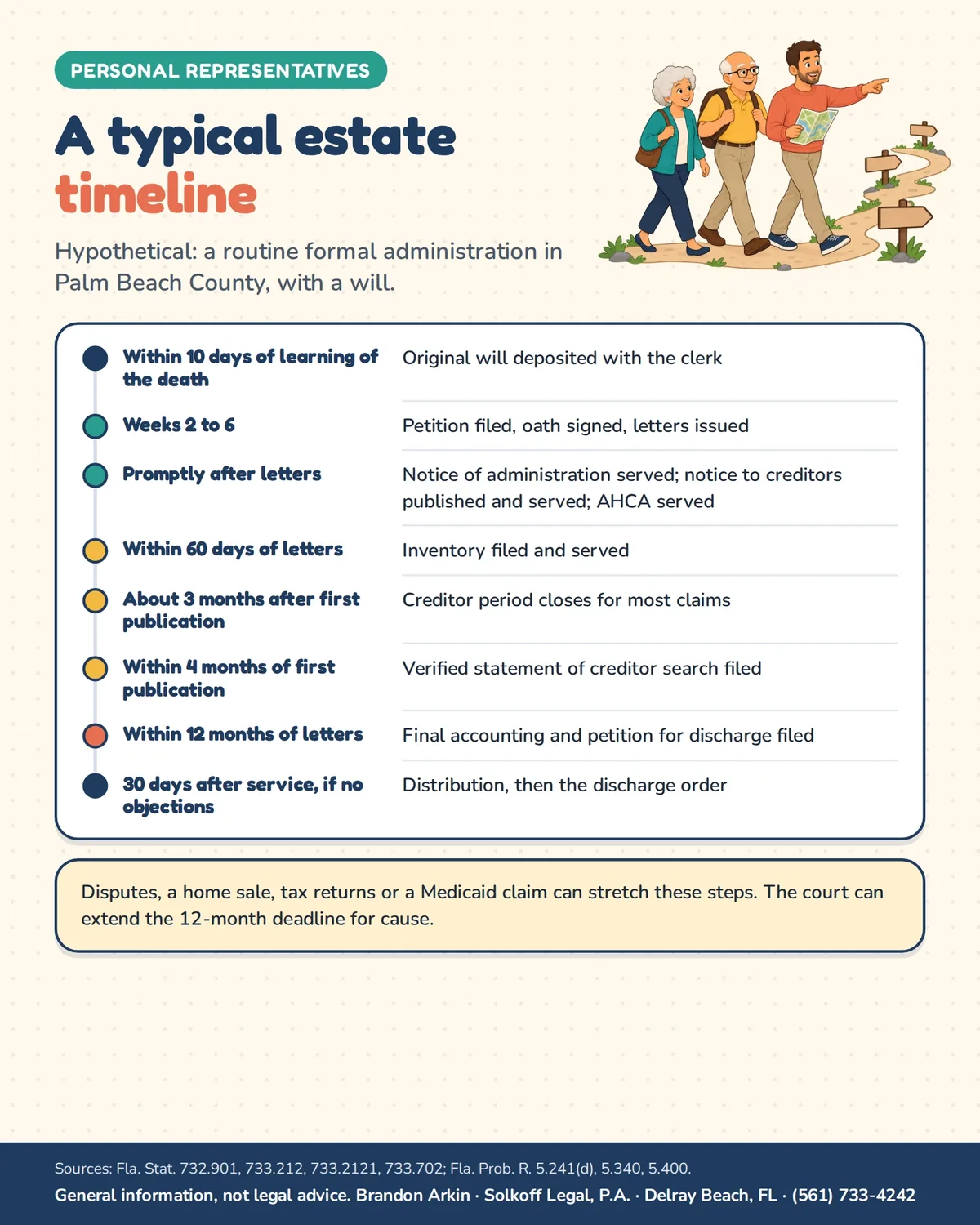
A typical timeline (hypothetical)
Rosa's father died in Greenacres in March with a will naming her personal representative, a condo and two bank accounts. A routine formal administration might run like this:
| When | Step |
|---|---|
| Within 10 days of learning of the death | Original will deposited with the Palm Beach County clerk |
| Weeks 2 to 6 | Petition filed, oath signed, letters issued |
| Promptly after letters | Notice of administration served; notice to creditors published and served; AHCA served |
| Within 60 days of letters | Inventory filed and served |
| About 3 months after first publication | Creditor period closes for most claims |
| Within 4 months of first publication | Verified statement of creditor search filed |
| Within 12 months of letters | Final accounting and petition for discharge filed |
| 30 days after service, if no objections | Distribution, then the discharge order |
When
Within 10 days of learning of the death
Step
Original will deposited with the Palm Beach County clerk
When
Weeks 2 to 6
Step
Petition filed, oath signed, letters issued
When
Promptly after letters
Step
Notice of administration served; notice to creditors published and served; AHCA served
When
Within 60 days of letters
Step
Inventory filed and served
When
About 3 months after first publication
Step
Creditor period closes for most claims
When
Within 4 months of first publication
Step
Verified statement of creditor search filed
When
Within 12 months of letters
Step
Final accounting and petition for discharge filed
When
30 days after service, if no objections
Step
Distribution, then the discharge order
Personal representative task checklist
Work through this with the estate's attorney. Nothing is saved.
Tick boxes stay on this device. Nothing is saved or sent.
Common questions
Can I turn down being personal representative in Florida?
Yes. Being named in a will doesn't force you to serve. You can decline before appointment, and the court then looks to the next person in line, such as an alternate named in the will or someone chosen by a majority in interest of the beneficiaries. If you've already been appointed and want to stop, you generally need court permission to resign and must account for what you handled. Declining doesn't affect what you inherit under the will.
Can a personal representative live out of state?
Only if they're a qualifying relative. Under Fla. Stat. 733.304, a nonresident can serve if they're an adopted child or adoptive parent, a lineal relative such as a child or grandchild, a spouse, a brother, sister, uncle, aunt, niece or nephew or someone lineally related to one of them, or the spouse of a person on that list. A nonresident friend can't serve, even if the will names them. The court may also require a bond and a resident agent.
When can a personal representative pay the beneficiaries?
Usually not until the creditor period has closed and timely claims are paid, settled or provided for, along with taxes and expenses. Paying out early is one of the main ways a personal representative ends up personally responsible for a debt. A small partial distribution is sometimes possible when the estate clearly has more than enough. The full distribution normally follows the plan in the petition for discharge, after interested persons have had 30 days to object.
Can the personal representative also inherit from the estate?
Yes. It's common for an adult child to be both a beneficiary and the personal representative. The dual role means extra care is needed: treat every beneficiary evenhandedly, keep clear records, and avoid buying estate property or using it personally without consent of the others or court approval. A personal representative who keeps siblings informed, shares the inventory and accountings and explains delays usually prevents the disputes that lead to objections.
If your family is facing one of these questions, you can reach Brandon Arkin at Solkoff Legal, P.A. at (561) 733-4242.
Related on this site
Talk through the next step
Bring your questions, a list of accounts and any papers a hospital, nursing home or Medicaid office has sent you. Call the Delray Beach office or request a consultation, and I can look at where things stand and what may come next. A phone call or an email does not by itself create an attorney-client relationship.
Solkoff Legal, P.A. · (561) 733-4242