
Resources · Probate and estates
Partition of inherited property in Florida: when co-owners can't agree
By Brandon Arkin, elder law attorney, Solkoff Legal, P.A. · Updated November 2026
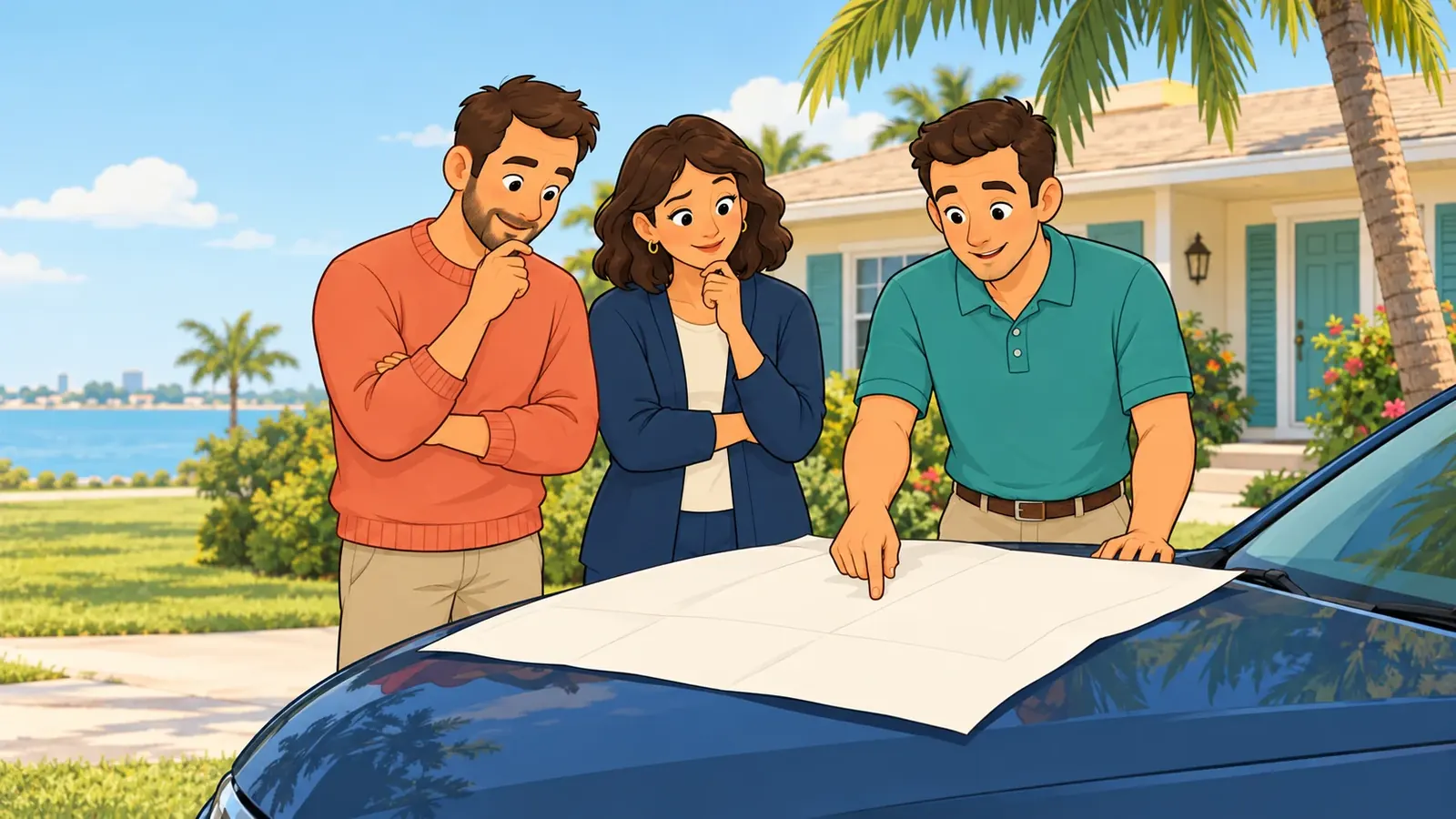
In Florida, any co-owner of inherited real estate can generally ask a circuit court to partition it, meaning divide it or, more often for a single house, order it sold and split the proceeds. When the property is "heirs property" under Florida's version of the Uniform Partition of Heirs Property Act, the court must first set a value and give the co-owners who want to keep it a chance to buy out those who asked for a sale.
How heirs end up owning property together
Co-ownership after a death usually comes about in one of three ways. A will leaves the house "to my children in equal shares." There's no will, and the intestacy rules pass it to several heirs. Or the house was homestead and the owner left a spouse and descendants: the spouse takes a life estate with the remainder to the descendants, or may elect within 6 months after the death to take an undivided half as a tenant in common with the descendants (Fla. Stat. 732.401).
Each co-owner holds an undivided share of the whole property, not a particular room or acre. When one dies, that share passes through their own estate rather than to the other co-owners, so the number of owners can grow with each generation. That's how a family lot ends up with a dozen owners, some of whom have never met.
Before partition is possible, title usually has to be cleared. If the house is still in the parent's name, a probate or homestead determination often comes first. See personal representative duties and probate in Florida.
Partition under Chapter 64
A partition case is a lawsuit filed in circuit court. The complaint describes the property, names the co-owners and states their shares (Fla. Stat. 64.041). The court can divide the property itself, called partition in kind, when that's practical. A single-family home usually can't be split fairly, so the result is often a sale with the proceeds divided by share. Costs, including attorney's fees, can be paid from the property or its sale proceeds (Fla. Stat. 64.081), so a contested case reduces what everyone receives. Personal property, such as a boat or artwork, can be partitioned too (Fla. Stat. 64.091).
The heirs property act: extra protections for family land
Florida adopted the Uniform Partition of Heirs Property Act in 2020 as part II of Chapter 64 (Fla. Stat. 64.201). In every partition case, the court must decide whether the property is heirs property. If it is, the act's steps apply unless all co-owners agree otherwise in writing (Fla. Stat. 64.203).
Property generally qualifies when it's held as a tenancy in common with no binding agreement about partition, at least one co-owner received title from a relative, and relatives hold a large stake: 20% or more of the interests, or 20% or more of the co-owners (Fla. Stat. 64.202). Most homes inherited by siblings meet that test.
| Step | What happens |
|---|---|
| Value | The co-owners' agreed value, or a disinterested Florida-licensed appraiser; co-owners have 30 days after notice to object, and the court holds a hearing (64.206) |
| Buyout | Co-owners who didn't ask for a sale have 45 days to elect to buy the shares of those who did (64.207) |
| Division | If shares remain, the court favors partition in kind unless it would prejudice the co-owners as a group (64.208) |
| Factors | Practicality, effect on value, how long the family has owned it, ancestral or sentimental attachment, lawful use, and who paid taxes, insurance and upkeep (64.209) |
| Sale | Usually an open-market sale through a licensed broker, at no less than the set value unless the court approves otherwise after a hearing (64.210) |
Step
Value
What happens
The co-owners' agreed value, or a disinterested Florida-licensed appraiser; co-owners have 30 days after notice to object, and the court holds a hearing (64.206)
Step
Buyout
What happens
Co-owners who didn't ask for a sale have 45 days to elect to buy the shares of those who did (64.207)
Step
Division
What happens
If shares remain, the court favors partition in kind unless it would prejudice the co-owners as a group (64.208)
Step
Factors
What happens
Practicality, effect on value, how long the family has owned it, ancestral or sentimental attachment, lawful use, and who paid taxes, insurance and upkeep (64.209)
Step
Sale
What happens
Usually an open-market sale through a licensed broker, at no less than the set value unless the court approves otherwise after a hearing (64.210)
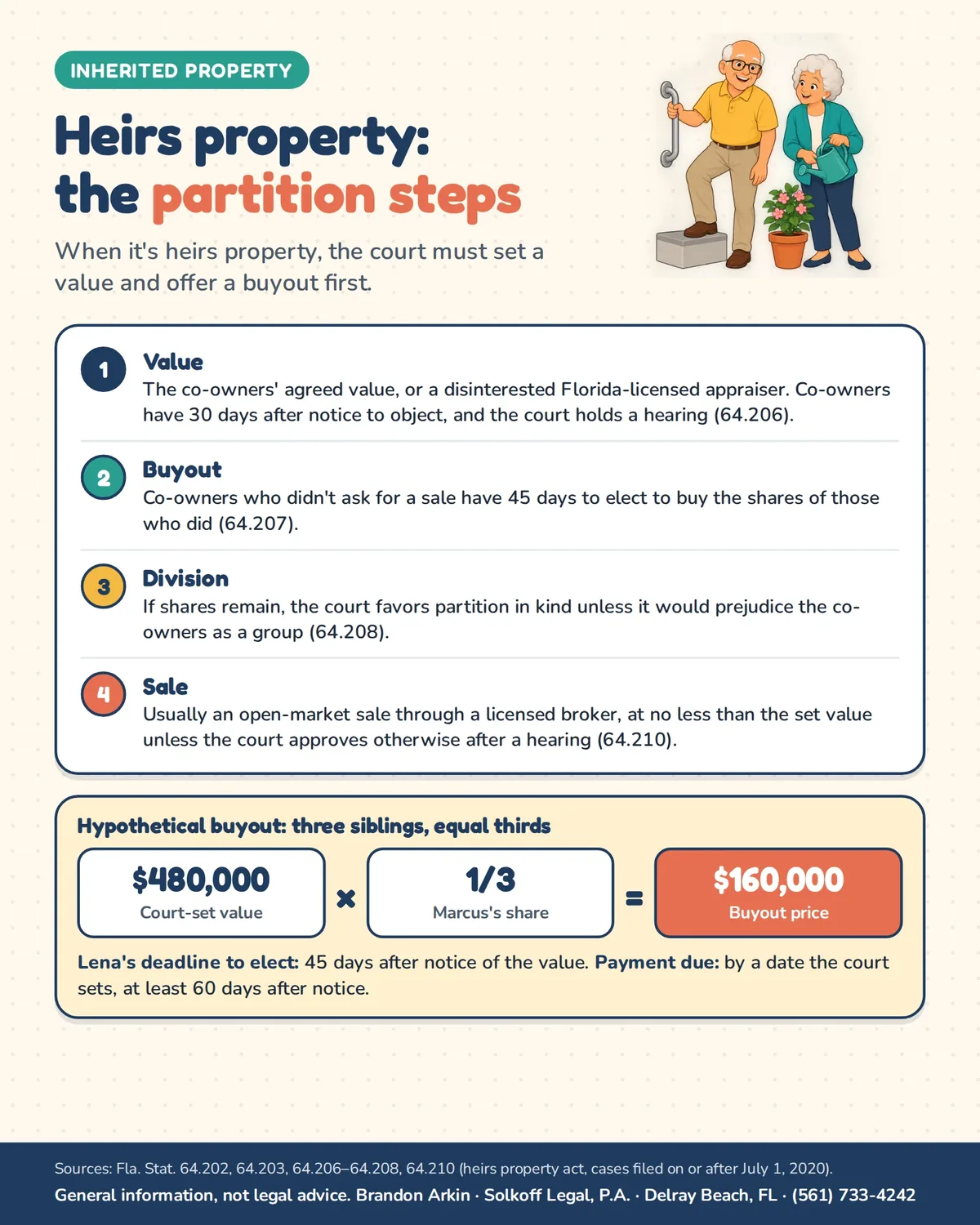
How a buyout works (hypothetical)
Three siblings inherit their mother's house in Boynton Beach in equal thirds. Marcus wants his money and files for partition. Lena lives nearby and wants to keep it, and Paul is willing to go along with her. The court finds it's heirs property and an appraiser values it at $480,000. The buyout price for an interest is the value times that interest's share:
| Item | Amount |
|---|---|
| Court-set value | $480,000 |
| Marcus's share | 1/3 |
| Buyout price for Marcus's share | $160,000 |
| Lena's deadline to elect | 45 days after notice of the value |
| Payment due | By a date the court sets, at least 60 days after notice |
Item
Court-set value
Amount
$480,000
Item
Marcus's share
Amount
1/3
Item
Buyout price for Marcus's share
Amount
$160,000
Item
Lena's deadline to elect
Amount
45 days after notice of the value
Item
Payment due
Amount
By a date the court sets, at least 60 days after notice
Options before, or instead of, a lawsuit
Most families do better when they settle the question themselves. Common paths include a voluntary buyout at an agreed appraisal; selling together and dividing the net proceeds; or a written co-ownership agreement covering who lives there, who pays taxes, insurance and repairs, and how and when the house will be sold.
Mediation is often the bridge. Families can hire a mediator before anyone files, and once a case is filed, the court may refer it to mediation (Fla. Stat. 44.102). A mediator doesn't decide anything; the siblings do. For ways to keep the conversation civil, see when siblings disagree.
If a co-owner receives Medicaid or SSI, cash from a buyout or sale can affect eligibility. Inheritances, settlements and Medicaid explains what to watch for.
Co-owner worksheet
Fill this in before talking with the family or an attorney. Nothing is saved.
Tick boxes stay on this device. Nothing is saved or sent.
Common questions
Can one sibling force the sale of an inherited house in Florida?
Generally, yes. Any co-owner can file a partition action under Fla. Stat. 64.031, and a single house that can't be divided fairly is often sold. But if the court finds it's heirs property, the others first get a buyout right: after the court sets the value, those who didn't request a sale have 45 days to elect to buy the requesting sibling's share at that value. A sale, if ordered, is usually on the open market through a licensed broker.
Who pays the costs of a partition case?
Usually the property does. Florida lets the court pay costs, including attorney's fees, out of the property or sale proceeds, so they're shared among co-owners and reduce everyone's net. In heirs property cases, the court also considers who paid taxes, insurance and upkeep when deciding how to divide or sell, and a co-owner may ask for an equitable accounting. Keeping receipts for what you've paid since the death can matter later.
Does the heirs property act apply to every inherited house?
No. It applies to partition actions filed on or after July 1, 2020, and only if the court finds the property is heirs property. That generally means a tenancy in common with no binding agreement on partition, at least one co-owner who took title from a relative, and relatives holding 20% or more of the interests or making up 20% or more of the co-owners. If all co-owners agree otherwise in writing, the standard Chapter 64 rules can apply instead.
Can we avoid court altogether?
Often, yes. Co-owners can agree on a value, one can buy out the others, or everyone can sign a listing agreement and divide the proceeds. A written co-ownership agreement can set rules for use, expenses and a future sale. A private mediator can help when talks stall. Partition remains available if agreement fails, but a negotiated result usually costs less and preserves family relationships. Have any agreement reviewed before it's signed.
If your family is facing one of these questions, you can reach Brandon Arkin at Solkoff Legal, P.A. at (561) 733-4242.
Related on this site
Talk through the next step
Bring your questions, a list of accounts and any papers a hospital, nursing home or Medicaid office has sent you. Call the Delray Beach office or request a consultation, and I can look at where things stand and what may come next. A phone call or an email does not by itself create an attorney-client relationship.
Solkoff Legal, P.A. · (561) 733-4242