Resources · Probate and estates
Can't find the original will in Florida? Where to look and what the law presumes
By Brandon Arkin, elder law attorney, Solkoff Legal, P.A. · Updated November 2026
If a Florida original will was last in the person's own possession and can't be found after death, the law presumes they destroyed it on purpose to revoke it. The family can still ask the probate court to establish the lost will from a copy or testimony, but only with enough evidence to overcome that presumption; otherwise an earlier will, or Florida's intestacy rules, decides who inherits.
Where to look first
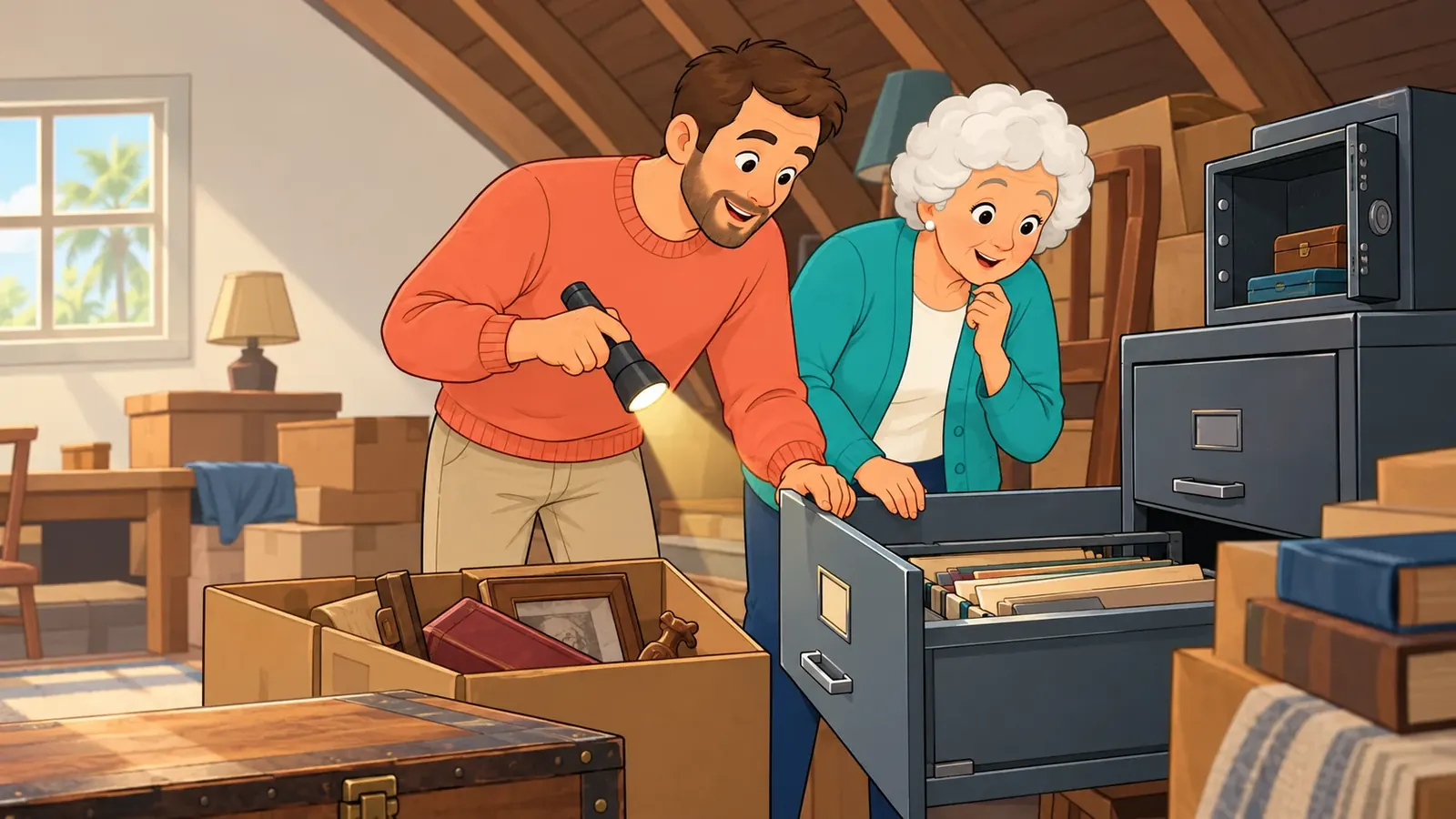
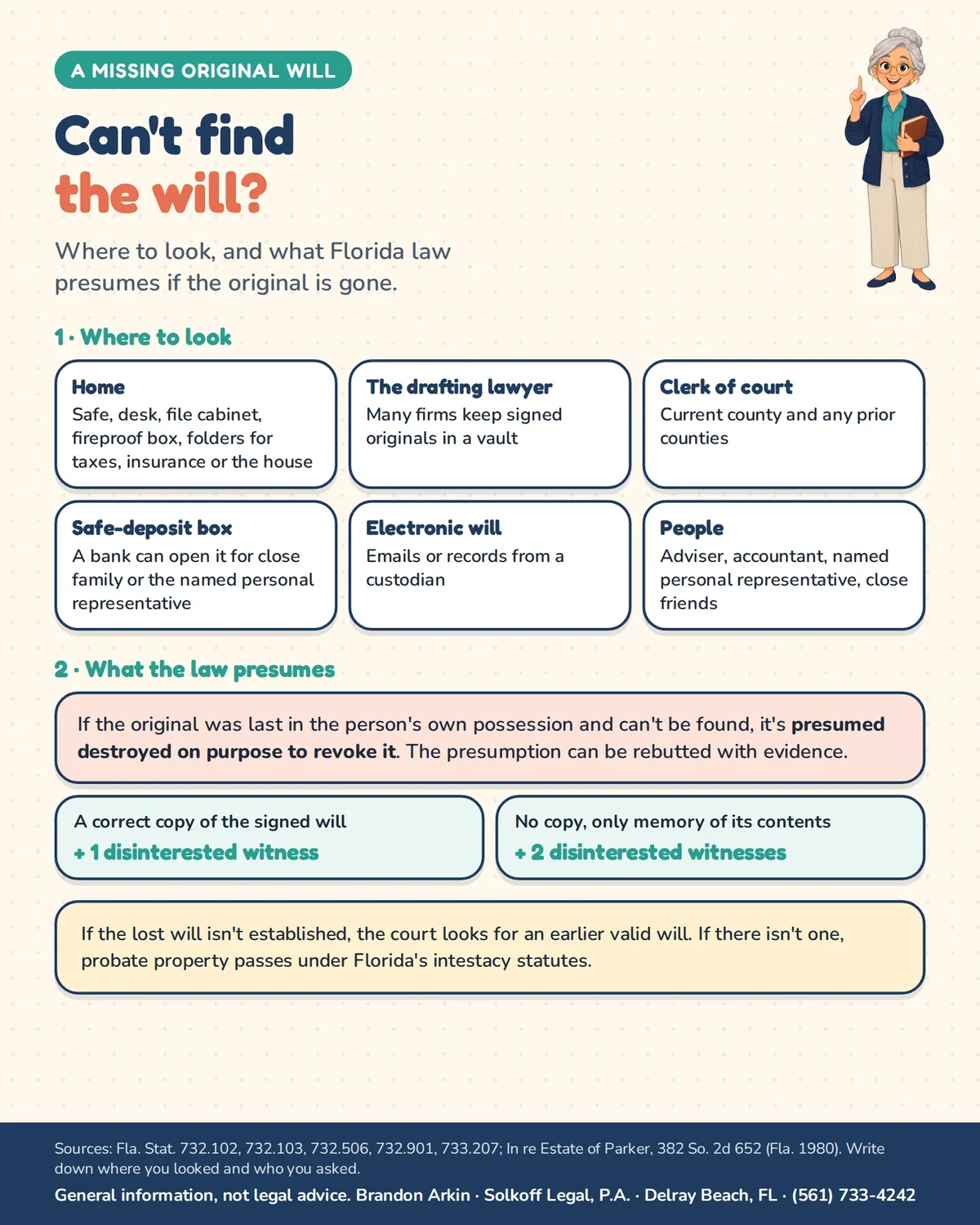
Most "lost" wills turn up. Start with the obvious places: a home safe, a desk or file cabinet, a fireproof box, a closet shelf, and folders labeled for taxes, insurance or the house. Then work outward.
The lawyer who drafted it. Many Florida law offices keep signed originals in a vault and give clients a copy. The firm's name is often printed on the copy's back cover or in the footer. If the firm has closed or the attorney has died, The Florida Bar or the attorney's successor firm may know where the files went.
The clerk of court. Someone may already have deposited the will after the death. Ask the clerk in the county where your parent lived, such as the Palm Beach County Clerk of the Circuit Court, and in any county where they lived before.
A safe-deposit box. Florida lets a bank open a box for close family or the personal representative named in a copy of the will, and release the will to the court. What to do after a death explains who may open it and what can be removed.
Electronic wills. Florida allows electronic wills, which are often held by a commercial custodian. If your parent signed one online, look for emails or account records from the provider.
Also ask the person's financial adviser, accountant, the named personal representative and close friends. Write down who you asked and when. That record can become evidence.
Why a copy usually isn't enough
Florida lets a person revoke a will by physically destroying or canceling it with that intent (Fla. Stat. 732.506). Because tearing up a will leaves nothing behind, Florida courts start from a presumption: when an original that is known to have existed can't be found after death, the testator is presumed to have destroyed it to revoke it (Brennan v. Estate of Brennan). The presumption applies when the will was in the testator's own custody, as when a lawyer handed the original to the client and she signed a receipt for it (Daul v. Goff).
The presumption is rebuttable. The person offering the lost will has the burden of presenting competent, substantial evidence that the testator didn't revoke it. Courts look at the facts: who last had the original, whether others had access to it, what the person said about the will near the end of life, and whether the will's plan still made sense. A copy alone usually doesn't carry that burden.
How a lost will is established
Any interested person may ask the court to establish the full and precise terms of a lost or destroyed will and admit it to probate (Fla. Stat. 733.207). Establishing and probating the will happen in one proceeding. The petition states the facts behind the request and the will's contents, or attaches a copy. Each witness's testimony is put in writing and filed. The court can't admit the will until formal notice goes to the people who would inherit without it, and the order must state the will's terms in full (Fla. Prob. R. 5.510).
Proving the terms and overcoming the presumption are separate hurdles. Both must be cleared.
| What you have | What the statute requires to prove the terms |
|---|---|
| A correct copy of the signed will | Testimony of 1 disinterested witness |
| No copy, only memory of its contents | Testimony of 2 disinterested witnesses |
| A draft or unsigned version | Generally not a substitute for a correct copy of the signed will |
What you have
A correct copy of the signed will
What the statute requires to prove the terms
Testimony of 1 disinterested witness
What you have
No copy, only memory of its contents
What the statute requires to prove the terms
Testimony of 2 disinterested witnesses
What you have
A draft or unsigned version
What the statute requires to prove the terms
Generally not a substitute for a correct copy of the signed will
If the will can't be proved: Florida intestacy
If the lost will isn't established, the court looks for an earlier valid will. If there isn't one, probate property passes under Florida's intestacy statutes. Accounts with a named beneficiary, joint accounts with survivorship and trust assets aren't affected either way.
The surviving spouse's share depends on the family (Fla. Stat. 732.102). Anything not going to the spouse passes in this order (Fla. Stat. 732.103):
| Family at death | Who takes the probate estate |
|---|---|
| Spouse, no descendants | Spouse takes all |
| Spouse, and all descendants are also the spouse's, and the spouse has no others | Spouse takes all |
| Spouse, and a child from another relationship on either side | Spouse takes half; descendants take half |
| No spouse, descendants | Descendants |
| No spouse or descendants | Parents, then siblings and their descendants |
| None of the above | Half to the paternal side and half to the maternal side, then the family of the last deceased spouse |
Family at death
Spouse, no descendants
Who takes the probate estate
Spouse takes all
Family at death
Spouse, and all descendants are also the spouse's, and the spouse has no others
Who takes the probate estate
Spouse takes all
Family at death
Spouse, and a child from another relationship on either side
Who takes the probate estate
Spouse takes half; descendants take half
Family at death
No spouse, descendants
Who takes the probate estate
Descendants
Family at death
No spouse or descendants
Who takes the probate estate
Parents, then siblings and their descendants
Family at death
None of the above
Who takes the probate estate
Half to the paternal side and half to the maternal side, then the family of the last deceased spouse
Example (hypothetical)
Walter, a widower in Jupiter, signed a will leaving his house to his daughter Ana, who cared for him, and nothing to his son. His lawyer gave him the original, and Ana kept a copy. After Walter dies, the original isn't in his desk or his safe-deposit box. Because Walter last had it, the law presumes he revoked it. Ana petitions to establish the will with the copy and the testimony of Walter's neighbor, a disinterested witness who heard him describe the plan weeks before he died. If the court finds the evidence sufficient, the copy is admitted. If not, the estate passes by intestacy, half to each child.
Will search checklist
Record each place you check and who you asked. Nothing is saved.
Tick boxes stay on this device. Nothing is saved or sent.
Common questions
Is a copy of a will valid in Florida?
A copy can be admitted, but not automatically. The court first needs evidence that overcomes the presumption that a missing original was revoked, unless the original was clearly out of the testator's hands. Then the will's terms must be proved, and with a correct copy that takes the testimony of one disinterested witness under Fla. Stat. 733.207. The proceeding requires formal notice to everyone who would inherit without the will, so they can object.
What if the lawyer who wrote the will has the original?
Then it isn't lost, and the presumption of revocation shouldn't arise. Once the firm learns of the death, it must deposit the original with the clerk of court in the county where the estate will be handled within 10 days, as required by Fla. Stat. 732.901. Family members can call the firm, provide the date of death and ask for confirmation of the deposit and a copy. Depositing a will doesn't open probate; a petition is still needed.
Who counts as a disinterested witness for a lost will?
Generally, a person who doesn't benefit under the lost will. A neighbor, friend, the drafting attorney or a legal assistant who knew the will's contents may qualify. A beneficiary usually doesn't, because they gain if the will is admitted. Fla. Stat. 733.207 requires one disinterested witness when a correct copy is provided and two when there's no copy. The witness's testimony is put in writing and filed with the court.
What happens if no will is ever found?
Probate property passes under Florida's intestacy statutes. A spouse takes everything if there are no descendants, or if all descendants are shared and the spouse has none from another relationship; otherwise the spouse takes half. Without a spouse, descendants inherit, then parents, then siblings and their descendants. Beneficiary designations, survivorship accounts and trusts still pass as written. The court appoints a personal representative using the order of preference for estates without a will.
If your family is facing one of these questions, you can reach Brandon Arkin at Solkoff Legal, P.A. at (561) 733-4242.
Related on this site
Talk through the next step
Bring your questions, a list of accounts and any papers a hospital, nursing home or Medicaid office has sent you. Call the Delray Beach office or request a consultation, and I can look at where things stand and what may come next. A phone call or an email does not by itself create an attorney-client relationship.
Solkoff Legal, P.A. · (561) 733-4242