
Resources · Estate planning
Beneficiary designation mistakes Florida families make, and how to avoid them
By Brandon Arkin, elder law attorney, Solkoff Legal, P.A. · Updated November 2026
The most common beneficiary designation mistakes in Florida are naming your estate, naming a minor or a person with a disability outright, leaving an ex-spouse on a form governed by federal law, naming no backup, and letting account forms drift out of line with your will or trust. Each can send money through probate, to the wrong person, or into a court-supervised account, and most can be fixed by reviewing and updating the forms.
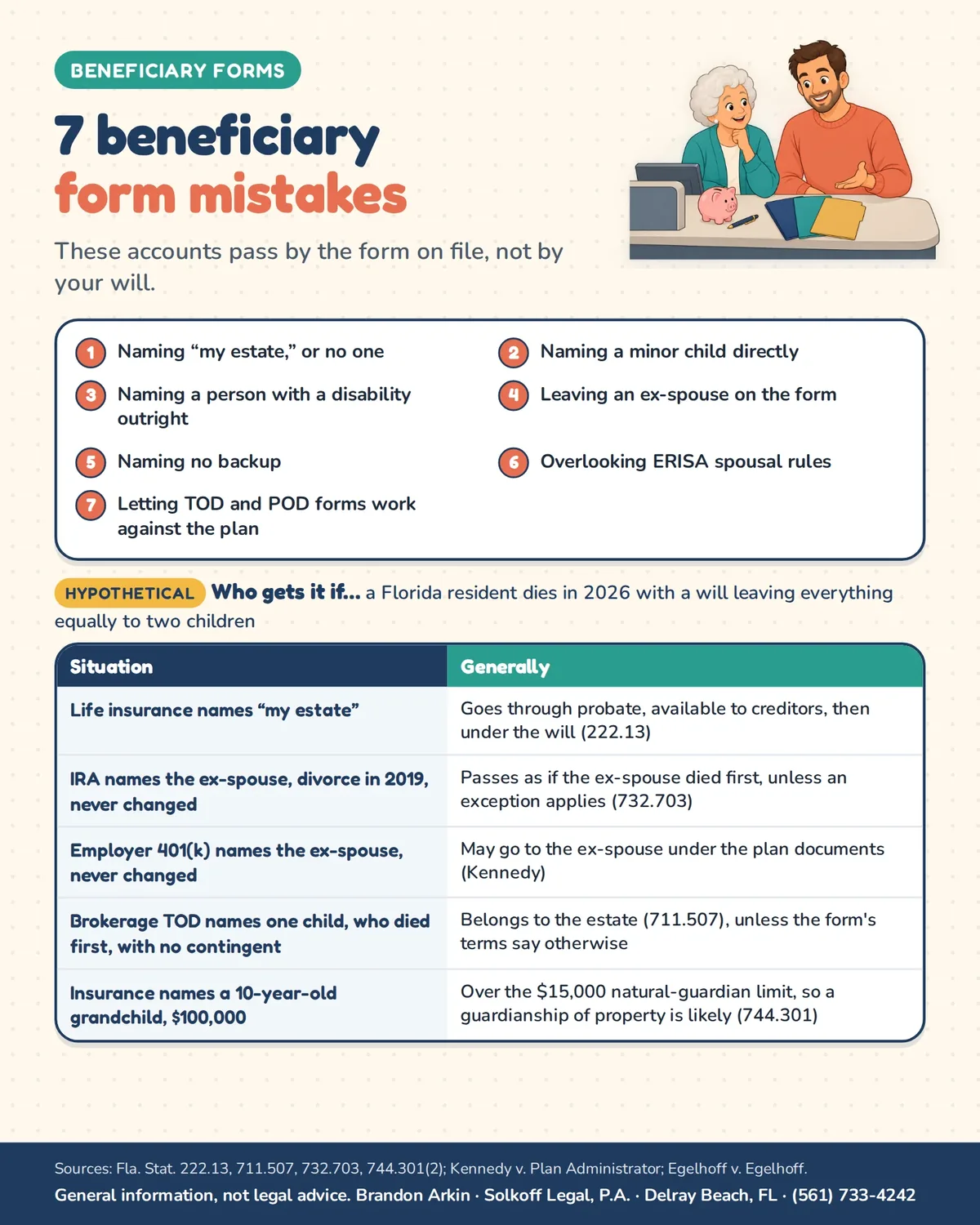
Naming "my estate," or no one
When a life insurance policy is payable to your estate, the proceeds become part of the estate "for all purposes" and are administered through probate (Fla. Stat. 222.13). That means delay, court costs, and exposure to your creditors, when the same proceeds paid to a named person would generally have been protected. Leaving the form blank, or naming someone who died before you, often has the same result, because many policies and plans default to the estate.
For retirement accounts, an estate is not an individual, so it generally can't stretch payouts the way a person can. Depending on your age at death, the heirs may have to withdraw and pay tax on the account faster. Our guide to Florida probate explains the process the estate would go through.
Naming a minor child directly
Insurers and plan administrators generally won't pay a large sum to a child. Florida lets parents, as natural guardians, collect and manage up to $15,000 in total for a minor without a court appointment, including life insurance and benefit plan proceeds (Fla. Stat. 744.301(2)). Above that, a court-supervised guardianship of the property is often needed, with annual accountings, and the child generally receives the money outright at 18.
Better options usually include naming a trust for the child, or a custodian under the Florida Uniform Transfers to Minors Act. Custodial property is generally turned over at 21, or at 25 if the custodianship was set up that way (Fla. Stat. 710.123). A trust can hold money longer and set its own rules.
Naming a person with a disability outright
Money left directly to someone who receives SSI or Medicaid generally counts as income when received and as a resource after that, which may push them over the $2,000 limit (20 CFR 416.1123). The usual fix is to name a third-party special needs trust as beneficiary. Retirement accounts left to certain trusts for a disabled or chronically ill beneficiary may also qualify for longer payout periods (26 U.S.C. 401(a)(9)(H)(iv)), but the trust has to be drafted for it. Our special needs planning guide explains the trust options.
Leaving an ex-spouse on the form
Florida has a safety net. If you were a Florida resident at death and your marriage was dissolved by court order, a designation of your former spouse made before the divorce is generally void, and the asset passes as if the former spouse died first. The rule covers life insurance, annuities, IRAs, payable-on-death and transfer-on-death accounts, and employee benefit plans (Fla. Stat. 732.703).
The exceptions are important. The rule doesn't apply where federal law provides otherwise, where you re-named the former spouse after the divorce, or where a court order or settlement requires you to keep them as beneficiary. Chapter 121 state retirement plans are excluded (732.703). For employer plans governed by ERISA, the U.S. Supreme Court held that a state revocation-on-divorce law was preempted (Egelhoff v. Egelhoff), and that the administrator properly paid the ex-spouse named in the plan documents (Kennedy v. Plan Administrator). For non-ERISA life insurance, the Court upheld a similar Minnesota statute (Sveen v. Melin). The safest course is to change the forms after a divorce, unless a court order says otherwise.
Naming no backup
If your only beneficiary dies before you and there's no contingent, the account may fall to your estate. Florida's transfer-on-death securities law says that if no beneficiary survives, the security belongs to the owner's estate (Fla. Stat. 711.507). Many forms also let you say what happens to a deceased child's share. Options such as "per stirpes" (to that child's descendants) differ from forms that split the share among the surviving beneficiaries. Read the form's definitions, because they vary.
Overlooking ERISA spousal rules
In many 401(k) and other employer plans, federal law makes the spouse the death beneficiary unless the spouse consents in writing to another choice. That consent must acknowledge its effect and be witnessed by a plan representative or a notary (29 U.S.C. 1055(b)(1)(C), (c)(2)). A form naming your children, with no valid spousal consent, may simply not work. This rule generally doesn't apply to IRAs, where your form controls, subject to Florida's homestead and elective share rules for other assets.
Remarried couples and blended families should check this closely. Our guide to remarrying later in life covers prenuptial agreements and other planning.
Letting TOD and POD forms work against the plan
Payable-on-death bank accounts and transfer-on-death brokerage accounts are useful probate-avoidance tools. Trouble starts when they're added one account at a time. A parent who puts one child on a $200,000 account and another child on a $20,000 account has made an unequal plan, even if the will says "equally." Those accounts also don't pay estate expenses, which can leave the probate estate short. And a TOD form naming your spouse can hurt if that spouse is on Medicaid; see when the healthy spouse dies first.
If you have a revocable trust, naming the trust as POD or TOD beneficiary often keeps everything consistent. Our guide to funding a revocable trust explains how.
Who gets it if…
Hypotheticals, assuming a Florida resident dies in 2026 with a will leaving everything equally to two children.
| Situation | Generally |
|---|---|
| Life insurance names "my estate" | Goes through probate, available to creditors, then under the will (222.13) |
| IRA names the ex-spouse, divorce in 2019, never changed | Passes as if the ex-spouse died first, unless an exception applies (732.703) |
| Employer 401(k) names the ex-spouse, never changed | May go to the ex-spouse under the plan documents (Kennedy) |
| Brokerage TOD names one child, who died first, with no contingent | Belongs to the estate (711.507), unless the form's terms say otherwise |
| Insurance names a 10-year-old grandchild, $100,000 | Over the $15,000 natural-guardian limit, so a guardianship of property is likely (744.301) |
Situation
Life insurance names "my estate"
Generally
Goes through probate, available to creditors, then under the will (222.13)
Situation
IRA names the ex-spouse, divorce in 2019, never changed
Generally
Passes as if the ex-spouse died first, unless an exception applies (732.703)
Situation
Employer 401(k) names the ex-spouse, never changed
Generally
May go to the ex-spouse under the plan documents (Kennedy)
Situation
Brokerage TOD names one child, who died first, with no contingent
Generally
Belongs to the estate (711.507), unless the form's terms say otherwise
Situation
Insurance names a 10-year-old grandchild, $100,000
Generally
Over the $15,000 natural-guardian limit, so a guardianship of property is likely (744.301)
Beneficiary review checklist
Request a copy of the current designation for each account. Don't rely on memory. Review after marriage, divorce, a birth or death, a move to Florida, or a new diagnosis in the family.
| Account | Primary | Contingent | Matches the will or trust? | Issue to check | Done |
|---|---|---|---|---|---|
| Life insurance (each policy) | Estate, minor or ex-spouse named? | ☐ | Group life through work | Old employer forms still on file? | ☐ |
| 401(k), 403(b), pension | Spousal consent needed? | ☐ | IRAs and Roth IRAs | Trust drafted for retirement accounts? | ☐ |
| Annuities | Owner, annuitant and beneficiary aligned? | ☐ | Bank POD accounts | Unequal amounts across children? | ☐ |
| Brokerage TOD accounts | Per stirpes or contingent named? | ☐ | Health savings account | Spouse vs. other heirs? | ☐ |
Account
Life insurance (each policy)
Primary
Estate, minor or ex-spouse named?
Contingent
☐
Matches the will or trust?
Group life through work
Issue to check
Old employer forms still on file?
Done
☐
Account
401(k), 403(b), pension
Primary
Spousal consent needed?
Contingent
☐
Matches the will or trust?
IRAs and Roth IRAs
Issue to check
Trust drafted for retirement accounts?
Done
☐
Account
Annuities
Primary
Owner, annuitant and beneficiary aligned?
Contingent
☐
Matches the will or trust?
Bank POD accounts
Issue to check
Unequal amounts across children?
Done
☐
Account
Brokerage TOD accounts
Primary
Per stirpes or contingent named?
Contingent
☐
Matches the will or trust?
Health savings account
Issue to check
Spouse vs. other heirs?
Done
☐
Tick boxes stay on this device. Nothing is saved or sent.
Common questions
Does my will override my beneficiary designations?
Generally no. Life insurance, retirement accounts, annuities, and payable-on-death or transfer-on-death accounts pass to the beneficiary named on the form, regardless of what your will says. The will controls only property that passes through probate. If the form names your estate, or no beneficiary survives, the asset may end up in probate and pass under the will (Fla. Stat. 711.507). That's why forms and documents should be reviewed together, and updated when your family changes.
What happens if my ex-spouse is still my beneficiary in Florida?
For many accounts, Florida voids a designation of a former spouse made before the divorce, and the asset passes as if the ex-spouse died first (Fla. Stat. 732.703). The rule has exceptions, including when federal law controls, when a court order requires the designation, or when you re-named the ex-spouse after the divorce. Employer plans under ERISA generally follow the plan documents, which may pay the ex-spouse (Kennedy v. Plan Administrator). Update every form after a divorce.
Can I name my minor grandchild as a life insurance beneficiary?
You can, but it often causes problems. Florida lets parents collect up to $15,000 in total for a minor without a court appointment (Fla. Stat. 744.301(2)). Above that, a guardianship of the property is often needed, and the child generally receives the money at 18. Naming a trust for the grandchild, or a custodian under the Florida Uniform Transfers to Minors Act, is usually smoother. Custodial property is generally turned over at 21, or 25 if set up that way (Fla. Stat. 710.123).
Should I name my revocable trust as beneficiary?
Often for bank, brokerage and life insurance accounts, because it keeps everything under one plan and can protect minors and other beneficiaries who need help. Retirement accounts are different. Naming a trust can affect how quickly heirs must withdraw and pay tax, and most non-spouse heirs face a 10-year payout (26 U.S.C. 401(a)(9)(H)). A trust written for retirement accounts may help. Spouses often have better options as direct beneficiaries. Review this with your lawyer and CPA.
If your family is facing one of these questions, you can reach Brandon Arkin at Solkoff Legal, P.A. at (561) 733-4242.
Related on this site
Talk through the next step
Bring your questions, a list of accounts and any papers a hospital, nursing home or Medicaid office has sent you. Call the Delray Beach office or request a consultation, and I can look at where things stand and what may come next. A phone call or an email does not by itself create an attorney-client relationship.
Solkoff Legal, P.A. · (561) 733-4242