
Resources · Medicaid planning
Life insurance and Medicaid in Florida: policies, funeral plans and burial funds
By Brandon Arkin, elder law attorney, Solkoff Legal, P.A. · Updated November 2026

For Florida long-term care Medicaid, life insurance counts only by its cash surrender value, and none of it counts if the total face value of all policies on that person is $2,500 or less. Term and burial insurance with no cash value are excluded, as are an irrevocable prepaid funeral contract, burial spaces, and up to $2,500 per spouse set aside for burial.
How DCF counts life insurance
DCF's rule for SSI-related Medicaid, which includes nursing home Medicaid and the long-term care waiver, has three parts (ESS 1640.0554):
A policy counts only to the extent of its cash surrender value, the amount the owner would receive by cashing it in. The death benefit itself isn't counted. If the face value of all policies on one person totals $2,500 or less, none of the cash value counts. Over $2,500, the cash value of all of them counts, not just the excess. Policies with no cash value, such as term or burial insurance, are left out entirely, including when adding up the face values.
Two details matter. The policy must be owned by the applicant, or by a spouse whose assets are counted with theirs. A policy your parent's child owns on your parent's life isn't your parent's asset. And the $2,500 is per person: one spouse can't have $5,000 of coverage on the theory that the couple gets $2,500 each.
For a married couple applying for nursing home Medicaid, the cash value of policies owned by either spouse is generally part of the couple's assets in the spousal calculation. See If one spouse needs nursing home care.
| What your parent has | Counted by Medicaid? |
|---|---|
| Term life, any face value | No |
| Burial insurance with no cash value | No |
| Whole or universal life, total face $2,500 or less | No |
| Whole or universal life, total face over $2,500 | Yes, the full cash surrender value of every policy |
| A policy on your parent's life owned by a child | Not your parent's asset |
| Irrevocable prepaid funeral contract | No |
| Revocable prepaid funeral contract | Yes, the refund value, unless an exception applies |
| Burial fund, up to $2,500, kept separate | No |
| Cemetery plot, crypt, casket or headstone for the family | No |
What your parent has
Term life, any face value
Counted by Medicaid?
No
What your parent has
Burial insurance with no cash value
Counted by Medicaid?
No
What your parent has
Whole or universal life, total face $2,500 or less
Counted by Medicaid?
No
What your parent has
Whole or universal life, total face over $2,500
Counted by Medicaid?
Yes, the full cash surrender value of every policy
What your parent has
A policy on your parent's life owned by a child
Counted by Medicaid?
Not your parent's asset
What your parent has
Irrevocable prepaid funeral contract
Counted by Medicaid?
No
What your parent has
Revocable prepaid funeral contract
Counted by Medicaid?
Yes, the refund value, unless an exception applies
What your parent has
Burial fund, up to $2,500, kept separate
Counted by Medicaid?
No
What your parent has
Cemetery plot, crypt, casket or headstone for the family
Counted by Medicaid?
No
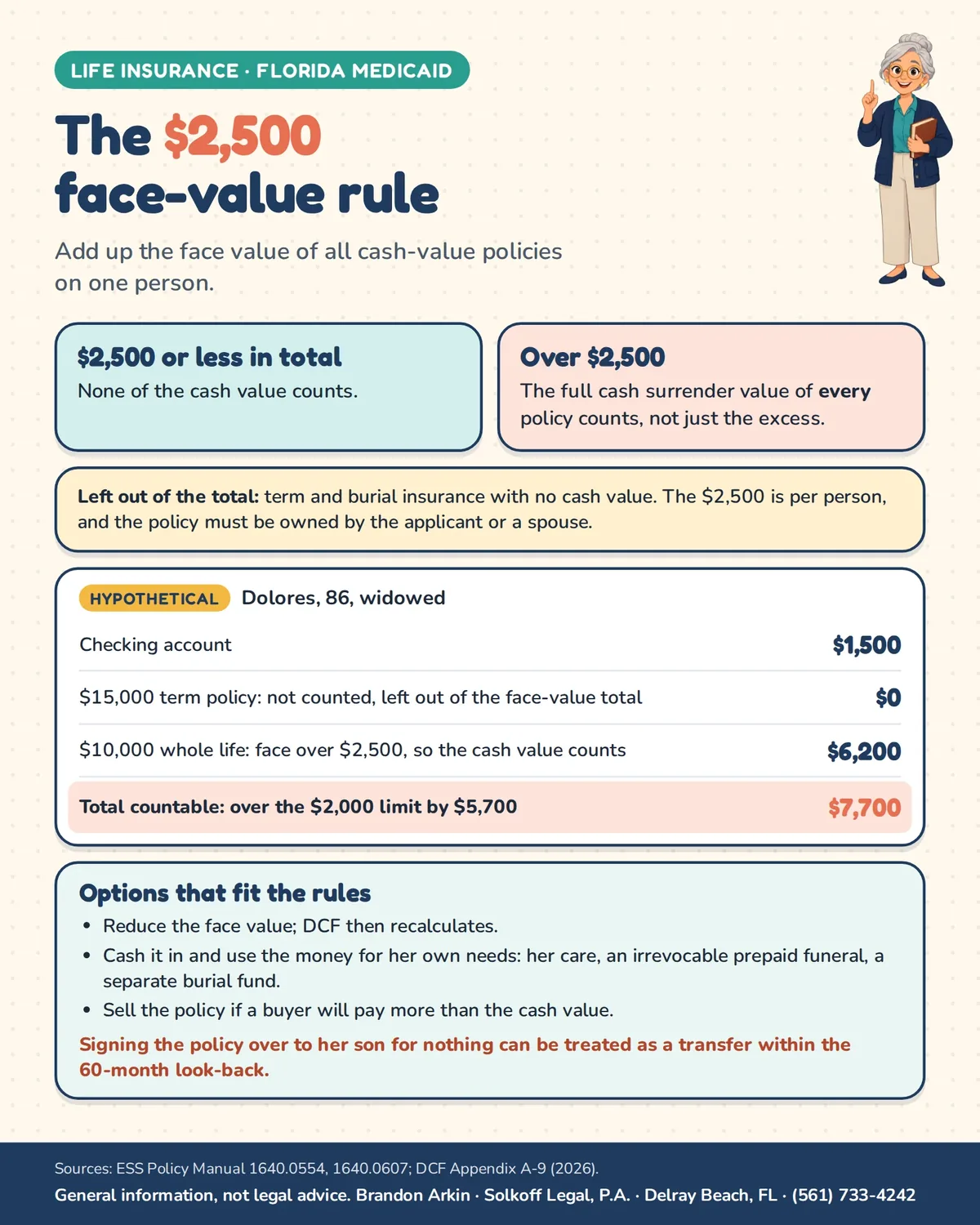
A worked example
Hypothetical: Dolores, 86, is widowed and lives in West Palm Beach. She is moving to a nursing home and applying for Medicaid. She has $1,500 in checking, a $10,000 whole life policy she bought in 1979 with a cash value of $6,200, and a $15,000 term policy through an old employer.
| Item | Counted? |
|---|---|
| Checking account | $1,500 |
| Term policy, $15,000 | Not counted, and left out of the face-value total |
| Whole life policy, $10,000 face | Face over $2,500, so the $6,200 cash value counts |
| Total countable | $7,700, over the $2,000 limit by $5,700 |
Item
Checking account
Counted?
$1,500
Item
Term policy, $15,000
Counted?
Not counted, and left out of the face-value total
Item
Whole life policy, $10,000 face
Counted?
Face over $2,500, so the $6,200 cash value counts
Item
Total countable
Counted?
$7,700, over the $2,000 limit by $5,700
Prepaid funeral contracts
A prepaid burial contract, called a preneed contract in Florida, is an agreement with a funeral home or cemetery to pay now for services and merchandise later. DCF doesn't count it as an asset if it is irrevocable, if the seller refuses to cancel it, or if cancelling would cause significant hardship (ESS 1640.0509). Otherwise, DCF counts the amount your parent would get back by cancelling, minus any penalty, which is often different from the face value (ESS 1640.0511.02).
Florida preneed contracts are generally cancelable. A purchaser can cancel within 30 days for a full refund, and can cancel the services portion later. But Florida law lets a purchaser who is the beneficiary and who is applying for or receiving Medicaid or SSI make the contract irrevocable. Once that is done, it can't be cancelled, and any money left over after the funeral goes to the state's Medical Care Trust Fund (Fla. Stat. 497.459). DCF's policy confirms that any Medicaid applicant may make a contract irrevocable and exclude it (ESS 1640.0510).
Practical points:
Ask the funeral home for an itemized contract and a written statement that it is irrevocable. DCF will want a copy (ESS 1640.0513). Buy for fair value. Paying a reasonable price for a funeral is spending on your parent's own needs. A contract worth far more than the services may draw questions. An irrevocable burial trust set up with a funeral home is treated like an irrevocable contract. One that isn't connected to a funeral home is treated as a transfer, apart from up to $2,500 that can be excluded as a burial fund (ESS 1640.0512).
Burial funds and burial spaces
Separately from a funeral contract, your parent, and their spouse, can each set aside up to $2,500 for burial expenses. The money must be kept separate, not mixed with other savings. DCF accepts your parent's statement of how much is set aside and for whom, or form CF-ES 2302, Designation of Resources for Burial Funds. Interest left to grow in the fund is also excluded. The $2,500 isn't reduced by excluded life insurance or an irrevocable funeral contract. Funds can even be designated for the three months before the application (ESS 1640.0514).
Burial spaces, meaning a grave site, crypt, mausoleum or urn, aren't counted if they are for your parent, their spouse or an immediate family member, which includes children, stepchildren, siblings, parents and their spouses. Caskets, headstones and the cost of opening and closing the grave are excluded too (ESS 1640.0516). A deed or sales contract for the plot is the usual proof.
For which other property is counted or excluded, see What assets are exempt for Medicaid in Florida.
Selling a policy: life settlements
Some older policyholders can sell a policy to a third party for more than its cash value. Florida regulates those sales under Part X of Chapter 626, "Viatical Settlements" (Fla. Stat. 626.991–626.99295). A provider must be licensed by the Office of Insurance Regulation (Fla. Stat. 626.9912).
For Medicaid, a sale doesn't make the value disappear. The money from the sale is your parent's and counts as an asset once it is received, so it needs to be planned for just like a cash surrender. A sale at a fair price generally isn't a gift. A sale may also have income tax consequences, and the family loses the death benefit. Compare the offer, the cash value and the policy's role in the estate plan before deciding, and check the buyer's Florida license.
Before you change anything
Don't let a policy lapse or cancel it in a hurry. A policy that is part of the plan may be worth keeping, and the choices differ for each policy. Check who the beneficiary is. If it names the spouse in care, see When the healthy spouse dies first. Report changes. If your parent is already on Medicaid, cashing in a policy or buying a funeral contract is a change to report within 10 days. See Medicaid renewals and reporting. Insurance agents can find more on product rules in our guide for insurance agents.
Policy and funeral-plan inventory
Fill this in for each policy and funeral plan before the Medicaid application.
Tick boxes stay on this device. Nothing is saved or sent.
Common questions
Does Florida Medicaid count my mother's life insurance?
Only the cash surrender value, and only if the total face value of her cash value policies is over $2,500. If the total face value is $2,500 or less, none of the cash value counts. If it is over, the cash value of every one of those policies counts toward the $2,000 asset limit, not just the excess. Term and burial insurance with no cash value aren't counted at all, and aren't included when adding up face values. A policy owned by someone else on her life isn't her asset.
Is a prepaid funeral exempt from Medicaid in Florida?
An irrevocable one is. DCF doesn't count a prepaid burial contract that is irrevocable, that the seller won't cancel, or that can't be cancelled without significant hardship. Florida preneed contracts are generally cancelable, but Florida law lets a purchaser who is the beneficiary and is applying for or receiving Medicaid make it irrevocable. Any unused money then goes to the state after the funeral. A revocable contract counts at the amount your parent would receive by cancelling it. Ask the funeral home for an itemized, irrevocable contract.
Can my parent sign a life insurance policy over to me before applying for Medicaid?
It isn't usually a good idea. Transferring ownership for nothing in return gives away the cash value, and that can be treated as a transfer within the 60-month look-back. In July 2026, each $10,645 of value transferred equals about one month without Medicaid nursing home coverage. Options that fit the rules include reducing the face value, cashing in the policy and spending the money on your parent's own needs, such as care or an irrevocable funeral contract, or selling the policy at fair value. Get advice first.
How much can be set aside for burial on Medicaid in Florida?
Up to $2,500 each for the applicant and their spouse, in a burial fund kept separate from other money. DCF accepts the applicant's statement or form CF-ES 2302, and interest left in the fund is also excluded. That $2,500 is in addition to an irrevocable prepaid funeral contract, which isn't counted, and to burial spaces for the family, such as a plot, crypt, casket or headstone. If the money is mixed with other savings, it has to be separated within 10 days for the exclusion to apply.
If your family is facing one of these questions, you can reach Brandon Arkin at Solkoff Legal, P.A. at (561) 733-4242.
Related on this site
Talk through the next step
Bring your questions, a list of accounts and any papers a hospital, nursing home or Medicaid office has sent you. Call the Delray Beach office or request a consultation, and I can look at where things stand and what may come next. A phone call or an email does not by itself create an attorney-client relationship.
Solkoff Legal, P.A. · (561) 733-4242