
Resources · Medicare
When to sign up for Medicare: the windows, the penalties and the Florida Medigap rules
By Brandon Arkin, elder law attorney, Solkoff Legal, P.A. · Updated November 2026

Most people should sign up for Medicare during the 7-month Initial Enrollment Period around their 65th birthday, ideally in the 3 months before the birthday month so coverage starts on time. You can safely delay Part B only if you or your spouse has group health coverage from current employment; you then have 8 months after that job or coverage ends to enroll without a penalty.
Last checked: the 2026 Part B premium is $202.90. CMS hadn't yet announced the 2027 Part B premium, so the penalty example below uses 2026 figures. The 2027 Part D base beneficiary premium of $41.33 is final. Fall Open Enrollment for 2027 coverage ends December 7, 2026.
The enrollment periods at a glance
Medicare has several windows, and each controls a different decision. Mixing them up is the most common way people end up with a gap or a penalty.
| Period | When | What it's for |
|---|---|---|
| Initial Enrollment Period | 7 months around your 65th birthday | Parts A and B; also first chance to join a drug or Medicare Advantage plan |
| Special Enrollment Period, employer coverage | Any time you're covered by current-employment group coverage, and 8 months after it ends | Part B (and premium Part A) without a penalty |
| General Enrollment Period | January 1 to March 31 each year | Part B if you missed the other windows; coverage starts the month after you sign up, and a penalty may apply |
| Open Enrollment | October 15 to December 7 | Change Medicare Advantage or drug plans for January 1 |
| Medicare Advantage Open Enrollment | January 1 to March 31 | If already in Medicare Advantage: one switch, or return to Original Medicare and join a drug plan |
| Medigap open enrollment | 6 months, starting the first month you're 65 or older and in Part B | Buy any Medigap policy without medical underwriting |
Period
Initial Enrollment Period
When
7 months around your 65th birthday
What it's for
Parts A and B; also first chance to join a drug or Medicare Advantage plan
Period
Special Enrollment Period, employer coverage
When
Any time you're covered by current-employment group coverage, and 8 months after it ends
What it's for
Part B (and premium Part A) without a penalty
Period
General Enrollment Period
When
January 1 to March 31 each year
What it's for
Part B if you missed the other windows; coverage starts the month after you sign up, and a penalty may apply
Period
Open Enrollment
When
October 15 to December 7
What it's for
Change Medicare Advantage or drug plans for January 1
Period
Medicare Advantage Open Enrollment
When
January 1 to March 31
What it's for
If already in Medicare Advantage: one switch, or return to Original Medicare and join a drug plan
Period
Medigap open enrollment
When
6 months, starting the first month you're 65 or older and in Part B
What it's for
Buy any Medigap policy without medical underwriting
The Initial Enrollment Period: timing your start date
If you sign up for Part B in the 3 months before your birthday month, coverage starts the first day of your birthday month. If you sign up in the birthday month or the 3 months after, coverage starts the following month. Premium-free Part A starts the month you turn 65, or the month before if your birthday is on the 1st (Medicare.gov).
If you already receive Social Security, you're usually enrolled in Parts A and B automatically. Otherwise you apply through Social Security.
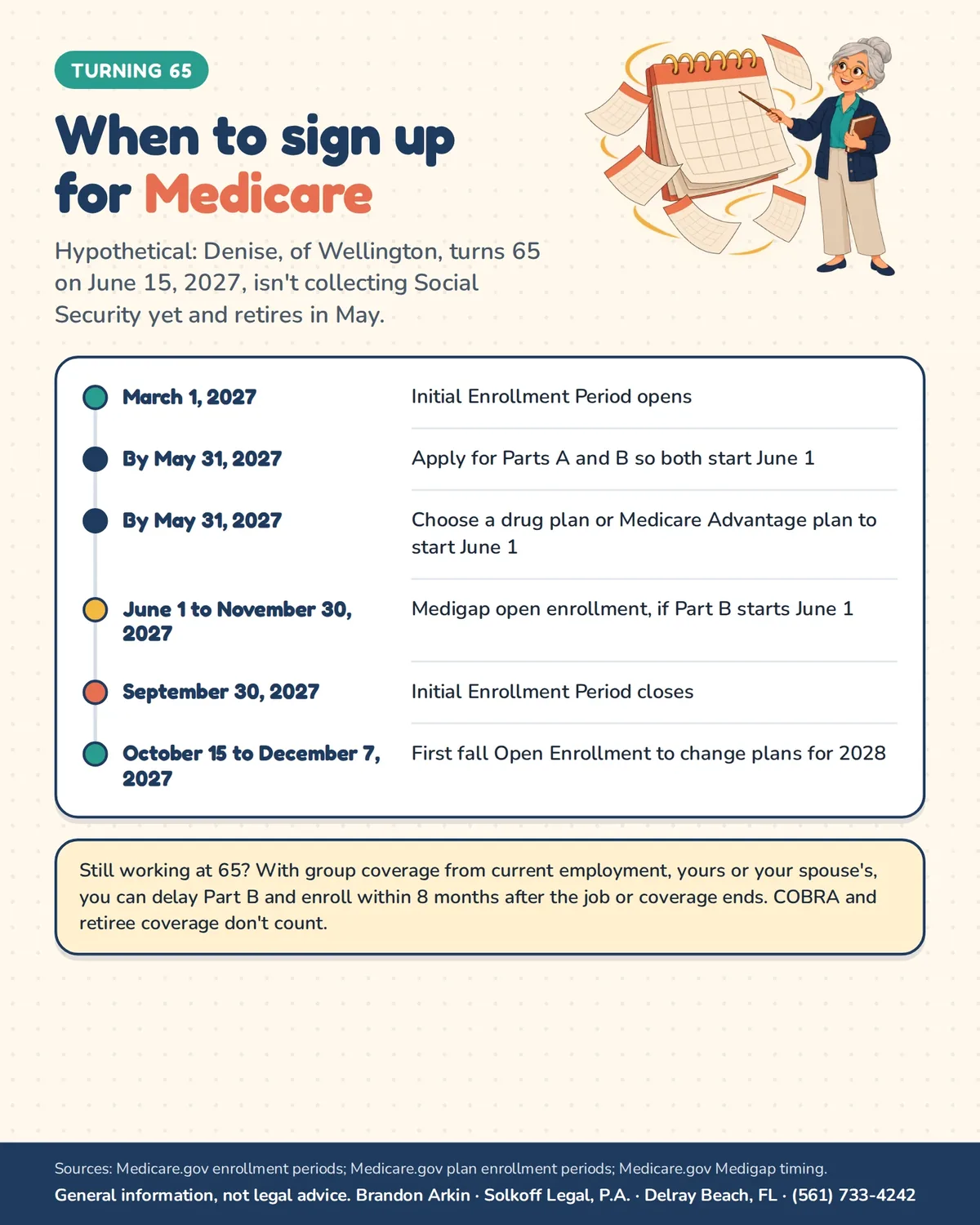
Hypothetical: Denise, of Wellington, turns 65 on June 15, 2027, and isn't collecting Social Security yet. She retires in May.
| Date | Step |
|---|---|
| March 1, 2027 | Initial Enrollment Period opens |
| By May 31, 2027 | Apply for Parts A and B so both start June 1 |
| By May 31, 2027 | Choose a drug plan or Medicare Advantage plan to start June 1 |
| June 1 to November 30, 2027 | Medigap open enrollment, if Part B starts June 1 |
| September 30, 2027 | Initial Enrollment Period closes |
| October 15 to December 7, 2027 | First fall Open Enrollment to change plans for 2028 |
Date
March 1, 2027
Step
Initial Enrollment Period opens
Date
By May 31, 2027
Step
Apply for Parts A and B so both start June 1
Date
By May 31, 2027
Step
Choose a drug plan or Medicare Advantage plan to start June 1
Date
June 1 to November 30, 2027
Step
Medigap open enrollment, if Part B starts June 1
Date
September 30, 2027
Step
Initial Enrollment Period closes
Date
October 15 to December 7, 2027
Step
First fall Open Enrollment to change plans for 2028
Still working at 65? When it's safe to wait
You can delay Part B without a penalty if you have group health coverage based on your own or your spouse's current employment. The Special Enrollment Period lasts until 8 months after the employment or the coverage ends, whichever happens first (Medicare.gov). To use it, Social Security needs proof of the group coverage, usually a form completed by the employer.
Three traps catch people:
COBRA and retiree coverage don't count. Neither is coverage from current employment. Enrolling in COBRA doesn't extend the 8 months.
Small employers. With an employer of fewer than 20 employees, Medicare is generally the primary payer at 65, so the group plan may pay little if you skip Part B. Ask the plan in writing (Medicare.gov).
Health savings accounts. If you sign up for Part A after 65, it can start up to 6 months back, though not before the month you turned 65 (Medicare.gov). Medicare advises stopping HSA contributions at least 6 months before you apply, to avoid a tax penalty (Medicare.gov); confirm the timing with a tax adviser.
Late penalties: how they're figured
The Part B penalty is 10% of the standard premium for each full 12-month period you went without Part B when you could have had it, and it lasts as long as you have Part B. The Part D penalty is 1% of the national base beneficiary premium for each month you went 63 days or more without a drug plan or other creditable drug coverage, and it lasts as long as you have drug coverage (Medicare.gov). People who qualify for Extra Help, or who enroll in a Medicare Savings Program, generally avoid these penalties; see Medicare Savings Programs in Florida.
| Example | Calculation | Monthly cost |
|---|---|---|
| Part B delayed 24 months, no Special Enrollment Period (2026) | $202.90 + 20% ($40.58) | $243.50 |
| No creditable drug coverage for 14 months (2027 base) | 14% × $41.33 | $5.80 added to the plan premium |
Example
Part B delayed 24 months, no Special Enrollment Period (2026)
Calculation
$202.90 + 20% ($40.58)
Monthly cost
$243.50
Example
No creditable drug coverage for 14 months (2027 base)
Calculation
14% × $41.33
Monthly cost
$5.80 added to the plan premium
Medigap in Florida: the 6-month window
Federal law gives a one-time 6-month Medigap open enrollment that starts the first month you're 65 or older and in Part B. During it, a company can't refuse to sell you any Medigap policy it offers or use your health to set the price (Medicare.gov). The window doesn't repeat each year.
Florida adds two protections. The same 6-month window applies to Floridians under 65 who are on Medicare because of a disability or end-stage renal disease and are in Part B. And a Floridian in Part B can buy a Medigap policy without health screening during the 2 months after group health coverage ends (Fla. Stat. 627.6741(1)(a)). After those windows, insurers can generally underwrite. The comparison of Medicare Advantage and Medigap is covered in Medicare Advantage vs Medigap in Florida.
Medicare and long-term care planning
Medicare pays for only limited skilled nursing care, so enrollment choices don't replace long-term care planning. For free, unbiased counseling, Florida's SHINE program is available at 1-800-963-5337. If a nursing home stay is possible, see Medicaid planning in Florida.
Turning-65 checklist
Fill this in about 4 months before the birthday month. Nothing is saved.
Tick boxes stay on this device. Nothing is saved or sent.
Common questions
When should I sign up for Medicare if I'm turning 65?
During your 7-month Initial Enrollment Period, which starts 3 months before your birthday month. Signing up in those first 3 months means Part B starts on the 1st of your birthday month. Signing up later in the window delays coverage to the following month. If you already get Social Security, enrollment is usually automatic. The exception is people with group health coverage from their own or a spouse's current job, who may be able to wait.
Can I delay Part B if I'm still working?
Yes, if you have group health coverage based on your own or your spouse's current employment. You then have a Special Enrollment Period lasting until 8 months after the job or coverage ends, whichever comes first, with no penalty. COBRA and retiree plans don't count as current-employment coverage. If the employer has fewer than 20 employees, Medicare is generally primary at 65, so ask the plan in writing before skipping Part B.
What happens if I miss my Medicare enrollment deadline?
You can sign up during the General Enrollment Period, January 1 to March 31, with coverage starting the month after you enroll. You may owe a Part B penalty of 10% for each full 12 months you went without it, for as long as you have Part B. A separate Part D penalty applies after 63 days or more without creditable drug coverage. Enrolling in a Medicare Savings Program generally removes the Part B penalty.
Does Florida let me buy a Medigap policy any time?
No. Florida follows the federal one-time 6-month open enrollment, which starts when you're 65 or older and in Part B, and extends it to people under 65 on Medicare for disability or ESRD. Florida also requires insurers to sell to Part B enrollees, without health screening, during the 2 months after group health coverage ends. Outside those windows and a few federal situations where insurers must sell a policy, they can generally ask health questions and may decline or charge more.
If your family is facing one of these questions, you can reach Brandon Arkin at Solkoff Legal, P.A. at (561) 733-4242.
Related on this site
Talk through the next step
Bring your questions, a list of accounts and any papers a hospital, nursing home or Medicaid office has sent you. Call the Delray Beach office or request a consultation, and I can look at where things stand and what may come next. A phone call or an email does not by itself create an attorney-client relationship.
Solkoff Legal, P.A. · (561) 733-4242