
Resources · Benefits and Medicaid
Social Security COLA 2027: what the 3.6% increase changes for Florida seniors
By Brandon Arkin, elder law attorney, Solkoff Legal, P.A. · Updated November 2026

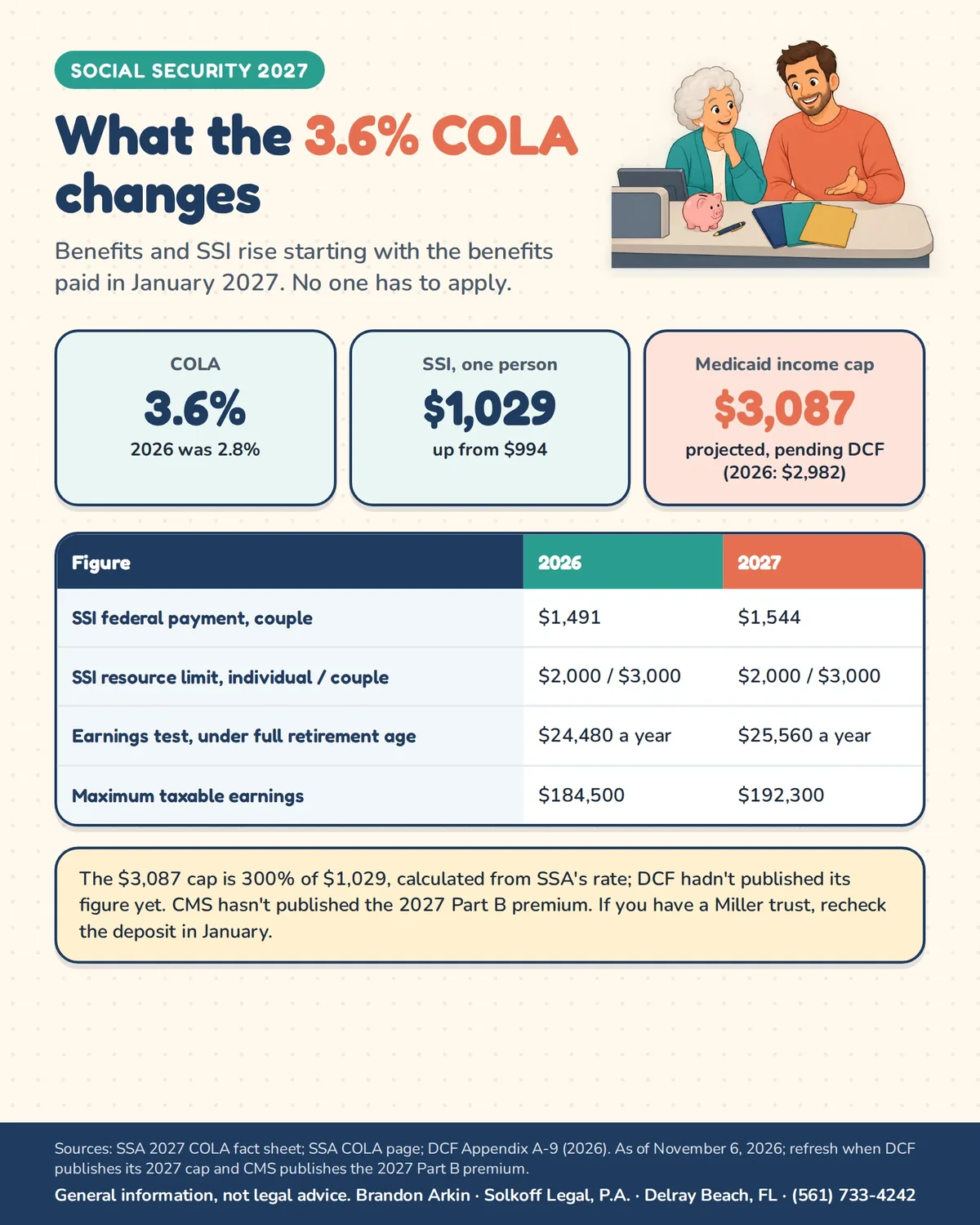
Social Security benefits and SSI payments rise 3.6% for 2027, starting with the benefits paid in January 2027, and the maximum federal SSI payment goes to $1,029 a month for one person. For Florida long-term care Medicaid, that SSI figure points to an income cap of $3,087 a month (300% of $1,029), but families should confirm DCF's new figure, the 2027 Part B premium and any Miller trust deposit amount in January.
Last checked: SSA has published the 2027 COLA and SSI rates. CMS hadn't yet announced the 2027 Part B premium and deductible, and DCF hadn't yet published its 2027 Appendix A-9. The $3,087 figure is our calculation from SSA's rate, not a DCF figure yet. We'll update this page when CMS and DCF publish.
What changes in January 2027
The COLA is automatic. No one has to apply (SSA OIG). It's based on the increase in the CPI-W from the third quarter of 2025 to the third quarter of 2026. Other 2027 figures moved with it (SSA fact sheet):
| Figure | 2026 | 2027 |
|---|---|---|
| COLA | 2.8% | 3.6% |
| SSI federal payment, individual | $994 | $1,029 |
| SSI federal payment, couple | $1,491 | $1,544 |
| SSI resource limit, individual / couple | $2,000 / $3,000 | $2,000 / $3,000 |
| Earnings test, under full retirement age | $24,480 a year | $25,560 a year |
| Maximum taxable earnings | $184,500 | $192,300 |
| Florida Medicaid long-term care income cap (300% of SSI) | $2,982 | $3,087 (calculated; pending DCF) |
Figure
COLA
2026
2.8%
2027
3.6%
Figure
SSI federal payment, individual
2026
$994
2027
$1,029
Figure
SSI federal payment, couple
2026
$1,491
2027
$1,544
Figure
SSI resource limit, individual / couple
2026
$2,000 / $3,000
2027
$2,000 / $3,000
Figure
Earnings test, under full retirement age
2026
$24,480 a year
2027
$25,560 a year
Figure
Maximum taxable earnings
2026
$184,500
2027
$192,300
Figure
Florida Medicaid long-term care income cap (300% of SSI)
2026
$2,982
2027
$3,087 (calculated; pending DCF)
The Part B premium and your net check
Most people have the Part B premium taken out of their Social Security, so the January deposit reflects the new benefit minus the new premium. In 2026 the standard premium is $202.90 (Medicare.gov). CMS sets the 2027 figure each fall.
Federal law protects many people from a net cut. If you got Social Security for November and December and your Part B premium is deducted from your December and January benefits, a premium increase generally can't reduce your net benefit below the prior year's net. This is often called the hold-harmless rule (42 U.S.C. 1395r(f)). It doesn't apply to people who pay an income-related surcharge (IRMAA), or to people newly enrolled in Part B.
If you receive Medicaid or a Medicare Savings Program that pays your Part B premium, the State pays it, so the premium increase doesn't come out of your check. See Medicare Savings Programs in Florida.
Medicare Savings Programs: a temporary pause
Federal law doesn't count the January COLA as income for the Medicare Savings Programs until the month after the new federal poverty guidelines are published (42 U.S.C. 1396d(p)(2)(D)). That keeps people from losing QMB, SLMB or QI help in January, before the income limits catch up. The 2027 limits will follow the new poverty guidelines, usually published early in the year.
Florida Medicaid: the income cap and patient responsibility
Florida's nursing home, assisted living and home-based long-term care Medicaid programs use an income cap of 300% of the SSI federal payment. That's $2,982 in 2026 (DCF Appendix A-9). At $1,029 for 2027, the same formula gives $3,087. DCF publishes the official figure in its updated Appendix A-9.
Two things follow. First, someone whose gross income was just under $2,982 may still be under the new cap after a 3.6% raise, because the cap rises by the same percentage. Second, a nursing home resident's patient responsibility, the monthly amount paid toward care, usually rises with the COLA, because more income is left after the $160 personal needs allowance (DCF Appendix A-9). Expect a DCF notice with the new amount, and pay the new figure when it takes effect. Medicaid renewals and reporting changes covers what to report and when.
Miller trust deposits: recheck the amount
A Miller trust (Qualified Income Trust) is needed when gross income is over the cap. The minimum monthly deposit is gross income minus the cap. Because income and the cap both change in January, a fixed deposit that worked in 2026 can come up short in 2027. How to set up a Miller trust explains the trust itself.
Hypothetical: a Lantana widow in a nursing home has $3,400 a month in gross income in 2026, all from Social Security. Her trustee deposits $418, the exact minimum. After a 3.6% raise, her benefit is about $3,522.
| 2026 | 2027 (estimated) | |
|---|---|---|
| Gross Social Security | $3,400 | about $3,522 |
| Income cap | $2,982 | $3,087 (pending DCF) |
| Minimum QIT deposit | $418 | about $435 |
| Left outside the trust if she keeps depositing $418 | $2,982 | about $3,104, over the cap |
Gross Social Security
2026
$3,400
2027 (estimated)
about $3,522
Income cap
2026
$2,982
2027 (estimated)
$3,087 (pending DCF)
Minimum QIT deposit
2026
$418
2027 (estimated)
about $435
Left outside the trust if she keeps depositing $418
2026
$2,982
2027 (estimated)
about $3,104, over the cap
Other benefits that move with the COLA
VA pension rates, including Aid and Attendance, usually rise each December 1 by the same percentage; see VA Aid and Attendance. Income-related Medicare surcharges for 2027 are based on the tax return from 2 years earlier, which for 2027 generally means 2025 income (Medicare & You). If a large one-time event, such as a home sale, raised 2025 income, plan for that.
January 2027 checklist
Use this for yourself or a parent. Nothing is saved.
Tick boxes stay on this device. Nothing is saved or sent.
Common questions
How much is the Social Security COLA for 2027?
It's 3.6%, announced by SSA on October 14, 2026. It applies to benefits for December 2026, which are paid in January 2027. SSI recipients see the increase in the payment dated December 31, 2026, which is the January payment. SSA estimates the average retired worker's monthly benefit will rise from about $2,095 to $2,170. The increase is automatic, and you don't need to apply or call anyone to receive it.
Will the 2027 COLA push my parent over the Medicaid income limit?
Usually not by itself, because Florida's long-term care income cap is tied to the SSI payment, which also rises 3.6%. The 2026 cap is $2,982; three times the 2027 SSI rate of $1,029 is $3,087. Someone who was under the cap in 2026 generally stays under it. Confirm the figure in DCF's updated Appendix A-9, and recheck any Miller trust deposit, because a fixed deposit can fall short when both numbers change.
Will the Part B premium eat up my COLA?
For most people, no. As of November 6, 2026, CMS hadn't announced the 2027 Part B premium; it was $202.90 in 2026. If your premium is deducted from your Social Security and you had Part B in the prior year, federal law generally keeps an increase from lowering your net check below last year's. That protection doesn't cover people paying an income-related surcharge or those newly enrolled. Medicaid or a Medicare Savings Program may pay the premium instead.
Does the COLA change my parent's nursing home patient responsibility?
Usually, yes. Patient responsibility is the income left after allowed deductions, such as the $160 personal needs allowance in 2026 and health insurance premiums the resident pays. When Social Security goes up, that amount generally goes up too, and DCF sends a notice with the new figure. Pay the new amount from its effective date, and tell the facility's business office. If there's a Miller trust, update the deposit at the same time.
If your family is facing one of these questions, you can reach Brandon Arkin at Solkoff Legal, P.A. at (561) 733-4242.
Related on this site
Talk through the next step
Bring your questions, a list of accounts and any papers a hospital, nursing home or Medicaid office has sent you. Call the Delray Beach office or request a consultation, and I can look at where things stand and what may come next. A phone call or an email does not by itself create an attorney-client relationship.
Solkoff Legal, P.A. · (561) 733-4242