
Resources guide
Palliative Care vs. Hospice in Florida: What's the Difference?
By Brandon Arkin, elder law attorney, Solkoff Legal, P.A. | Updated November 2026 · Updated November 2026

Palliative care is comfort-focused care for a serious illness that can start at diagnosis and continue alongside treatment aimed at a cure, while hospice is palliative care for someone with a life expectancy of six months or less who stops curative treatment for the terminal illness. As of November 2026, Original Medicare usually pays for palliative care like other medical care (mostly Part B, with a $283 deductible and 20% coinsurance), but hospice is a separate benefit with its own election and very low cost sharing.
Last checked: The Medicare figures on this page are the 2026 amounts (CMS). As of November 6, 2026, CMS had not yet published the 2027 Part B premium and deductible or the Part A deductible on the sources checked for this page. CMS usually announces them in the fall, and they take effect January 1, 2027.
Two kinds of comfort care
Palliative care treats the symptoms and stress of a serious illness: pain, shortness of breath, nausea, anxiety and the strain on the family. Florida's statute describes it as the "comprehensive management of the physical, psychological, social, spiritual, and existential needs of patients," especially suited to people with "incurable, progressive illnesses" (Fla. Stat. 765.102(6)). The same section says palliative care must include a chance to plan for end-of-life care and respect for advance directives wherever care is given.
Hospice is a specific, organized form of palliative care for people near the end of life. Federal rules describe it as a set of services coordinated by an interdisciplinary team for a terminally ill patient and the family (42 CFR 418.3).
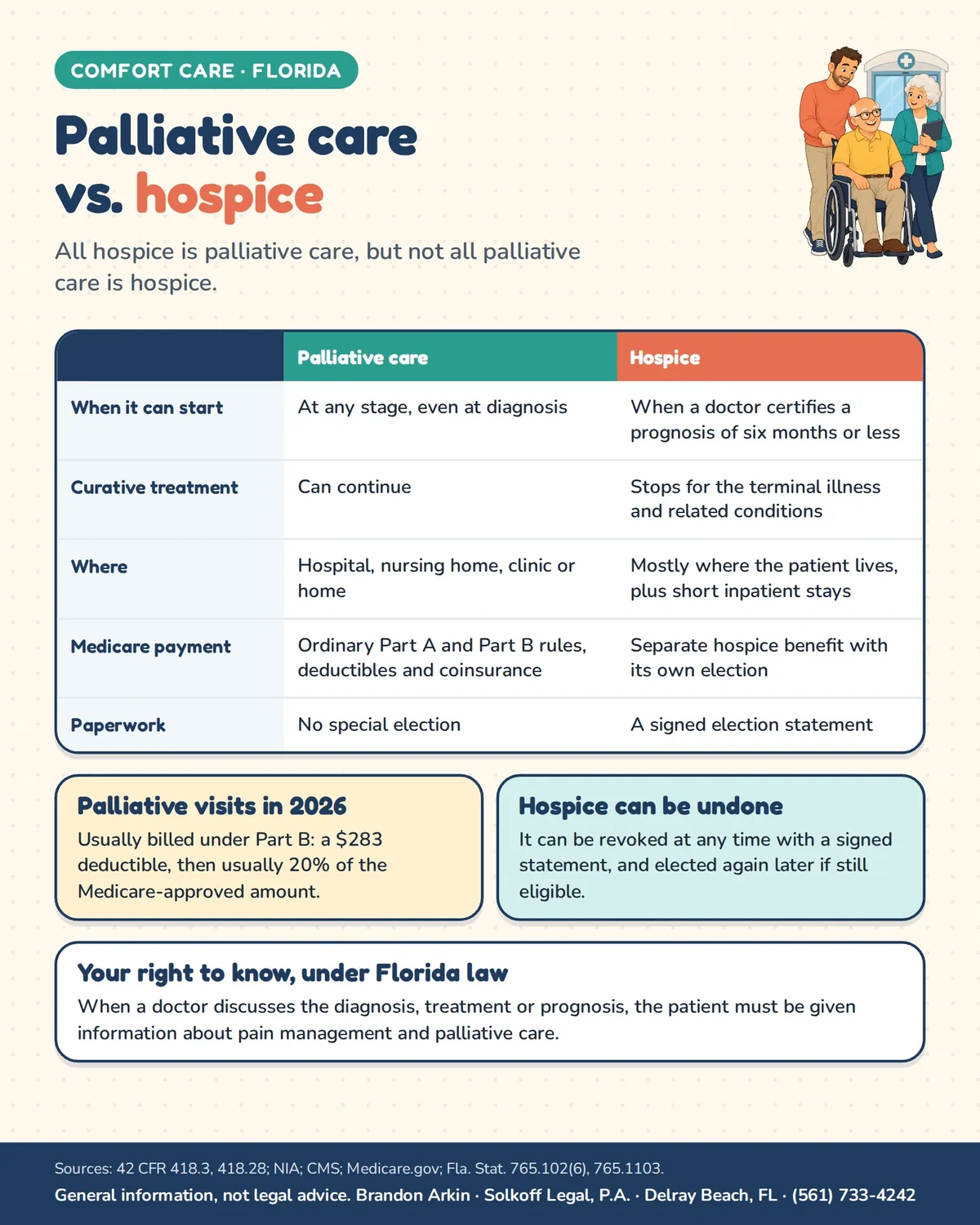
The simplest way to remember the difference: all hospice is palliative care, but not all palliative care is hospice.
Who qualifies for each
Palliative care has no prognosis requirement. A person with heart failure, cancer or dementia may receive it for years while still treating the illness. It's usually arranged by a referral from the treating doctor to a palliative care team. The team may include doctors, nurses, social workers and chaplains (NIA).
Hospice under Medicare requires a certification that the patient's life expectancy is six months or less "if the illness runs its normal course" (42 CFR 418.3). Our hospice, Medicare and Medicaid guide explains the certification, the election, the benefit periods and Medicaid's role in nursing home room and board. This page doesn't repeat those rules.
How palliative care is paid for
Original Medicare has no separate "palliative care benefit." Palliative visits are usually billed like other medical care. Coverage depends on the person's benefits and treatment plan (NIA). In practice:
Part B generally pays for office, clinic and home visits by doctors and nurse practitioners. In 2026, the Part B deductible is $283 (CMS), and after the deductible the patient usually pays 20% of the Medicare-approved amount (Medicare.gov). Part A applies to a hospital stay, where palliative consults often begin. The 2026 inpatient deductible is $1,736 (CMS). Part D, or the drug coverage in a Medicare Advantage plan, generally covers prescriptions for symptoms, under that plan's rules. Medigap may pick up some of the Part A and Part B cost sharing, depending on the plan. Medicare Advantage plans set their own copays and networks, so ask whether the palliative team is in network. Medicaid may cover palliative services for people who qualify, and private insurance depends on the plan (NIA).
Palliative care alone usually doesn't pay for an aide to help with bathing and dressing, or for a nursing home bed. Medicare doesn't pay for that kind of long-term custodial care (Medicare.gov). For that cost, see our Medicaid planning page.
Your rights to palliative care under Florida law
Florida gives patients two specific protections (Fla. Stat. 765.1103):
A right to information. When a doctor discusses the diagnosis, the treatment plan, alternatives, risks or prognosis, the patient must be told about pain management and palliative care. If the patient is incapacitated, the information goes to the health care surrogate or proxy, a guardian, or an agent under a durable power of attorney who has health care authority. A right to have a request honored. Physicians, osteopathic physicians and nurses must, as appropriate, comply with a request for pain management or palliative care from the patient or the patient's authorized decision-maker. Hospitals, nursing homes and assisted living facilities must comply with the palliative care measures the patient's physician orders.
This is one reason a signed health care surrogate designation matters. Without one, Florida's proxy statute sets the order of who decides (Fla. Stat. 765.401), and adult children may need a majority to agree.
Moving between palliative care and hospice
Many people start with palliative care and move to hospice when the illness advances and treatment aimed at a cure no longer helps. The move happens when a doctor certifies the six-month prognosis and the patient, or a representative, signs the hospice election.
The move can go the other way, too:
Revoking hospice. The patient or representative can revoke hospice with a signed, dated statement. The revocation can't be backdated. Medicare's standard coverage resumes, and the patient can elect hospice again later if still eligible (42 CFR 418.28). Discharge after improvement. A hospice may discharge a patient who is no longer terminally ill. The hospice must plan for that possibility and prepare the family (42 CFR 418.26). Palliative care can then continue under the ordinary Medicare rules.
People in a Medicare Advantage plan can stay in their plan during hospice. Original Medicare pays for care related to the terminal illness, and the plan still covers unrelated care and extra benefits as long as the premiums are paid (Medicare.gov).
The documents that shape these choices
Comfort care decisions often come up when the patient can no longer speak for themselves. In Florida, these documents do the work:
Health care surrogate designation. It names the person who can request palliative care, sign a hospice election or revoke one (Fla. Stat. 765.202). Living will. It records wishes about life-prolonging procedures if the person has a terminal condition, an end-stage condition or a persistent vegetative state (Fla. Stat. 765.302). See living will vs. last will. Do Not Resuscitate Order (DNRO). A DNRO is a Department of Health form that tells paramedics not to perform CPR. It's valid only on the state form (Fla. Stat. 401.45(3)), printed on yellow paper (Florida Department of Health). The clinician signs it, along with the patient or the patient's surrogate, proxy, guardian or authorized agent. Durable power of attorney. It handles the money side, such as paying for care or applying for benefits. See our five documents guide.
Medicare Part B covers voluntary advance care planning conversations. There's no cost when the planning is part of the yearly Wellness visit and the provider accepts assignment (Medicare.gov).
A hypothetical example
Consider a hypothetical 78-year-old man in Delray Beach with heart failure. After a hospital stay, his cardiologist refers him to a palliative care team. The team adjusts his medications for breathlessness and meets with him and his wife about his goals. He keeps seeing the cardiologist. The visits are billed under Part B, and his Medigap plan covers much of the coinsurance. A year later his condition declines, and his doctor certifies a six-month prognosis. He elects hospice at home, and his wife, as his named health care surrogate, already knows his wishes. With different facts, the timing and costs could be quite different.
Side by side
| Palliative care | Hospice | |
|---|---|---|
| When it can start | At any stage, even at diagnosis (NIA) | When a doctor certifies a prognosis of six months or less (42 CFR 418.3) |
| Curative treatment | Can continue | Stops for the terminal illness and related conditions |
| Where | Hospital, nursing home, clinic or home (NIA) | Mostly where the patient lives, plus short inpatient stays |
| Medicare payment | Ordinary Part A and Part B rules, deductibles and coinsurance | Separate hospice benefit with its own election |
| Paperwork | No special election | A signed election statement |
When it can start
Palliative care
At any stage, even at diagnosis (NIA)
Hospice
When a doctor certifies a prognosis of six months or less (42 CFR 418.3)
Curative treatment
Palliative care
Can continue
Hospice
Stops for the terminal illness and related conditions
Where
Palliative care
Hospital, nursing home, clinic or home (NIA)
Hospice
Mostly where the patient lives, plus short inpatient stays
Medicare payment
Palliative care
Ordinary Part A and Part B rules, deductibles and coinsurance
Hospice
Separate hospice benefit with its own election
Paperwork
Palliative care
No special election
Hospice
A signed election statement
Questions to ask the doctor
Tick the questions you want to bring to the next appointment. Nothing is saved.
Tick boxes stay on this device. Nothing is saved or sent.
Common questions
Do you have to be dying to get palliative care?
No. Palliative care can begin at diagnosis and can be given along with treatment that might cure the illness (NIA). Florida's statute describes it as especially suited to people with incurable, progressive illnesses, not only people at the very end of life (Fla. Stat. 765.102(6)). Hospice is the form of palliative care that requires a six-month prognosis (42 CFR 418.3).
Does Medicare pay for palliative care?
Often, yes, but not as a separate benefit. Palliative visits are usually billed like other medical care, so coverage depends on the person's benefits and treatment plan (NIA). Under Original Medicare in 2026, outpatient visits fall under Part B, with a $283 deductible (CMS) and then usually 20% coinsurance (Medicare.gov). Medigap or a Medicare Advantage plan changes what the patient pays. Hospice is different: it's a separate benefit with very low cost sharing.
Can someone leave hospice and go back to regular treatment?
Yes. The patient or representative can revoke hospice at any time with a signed statement that gives the effective date. Standard Medicare coverage then resumes, and the patient can elect hospice again later if eligible (42 CFR 418.28). A hospice may also discharge a patient whose condition improves so that they're no longer terminally ill (42 CFR 418.26). Palliative care can continue after either one.
Who can ask for palliative care if my parent can't speak for herself?
Under Florida law, a health care surrogate or proxy, a court-appointed guardian, or an agent under a durable power of attorney who has health care authority can request pain management or palliative care. Doctors and nurses must comply as appropriate (Fla. Stat. 765.1103). If no surrogate was named, Florida's proxy list applies, starting with a guardian, then the spouse, then a majority of adult children (Fla. Stat. 765.401). Signing a surrogate designation in advance avoids that uncertainty.
If your family is facing one of these questions, you can reach Brandon Arkin at Solkoff Legal, P.A. at (561) 733-4242.
Related on this site
Talk through the next step
Bring your questions, a list of accounts and any papers a hospital, nursing home or Medicaid office has sent you. Call the Delray Beach office or request a consultation, and I can look at where things stand and what may come next. A phone call or an email does not by itself create an attorney-client relationship.
Solkoff Legal, P.A. · (561) 733-4242