
Resources · Estate planning
Pet trusts in Florida: making sure your animals are cared for
By Brandon Arkin, elder law attorney, Solkoff Legal, P.A. · Updated November 2026
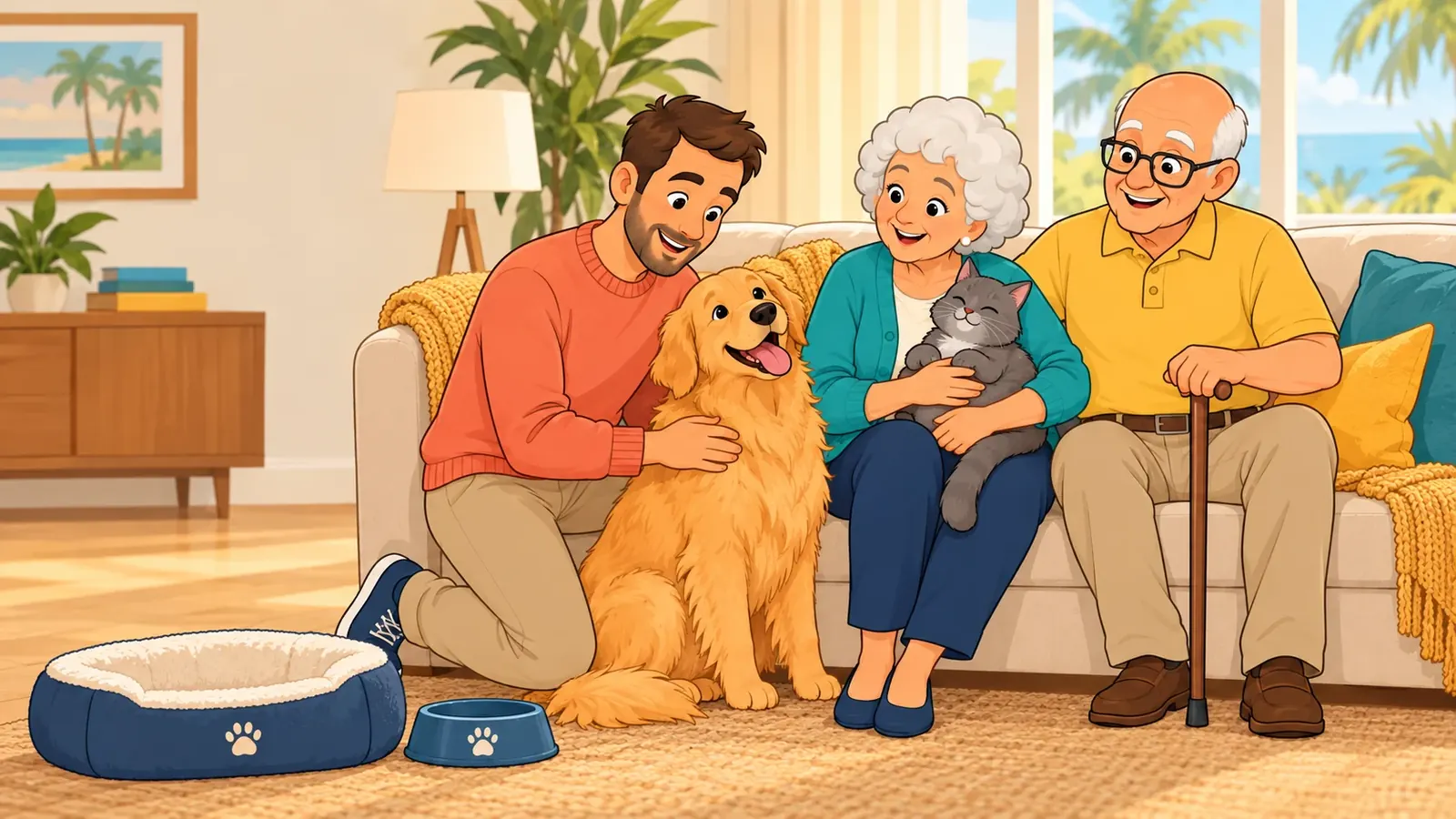
A Florida pet trust is a legally enforceable trust under section 736.0408 that holds money for the care of animals alive during your lifetime, and it ends when the last of those animals dies. You name a trustee to manage the money, a caretaker to look after the animal, and ideally a separate person to enforce the trust, and you decide where any leftover money goes.
Why a plan for pets needs its own document
Without a plan, a pet is handled like other personal belongings in an estate, and its care depends on whoever ends up with it. A will takes effect only after probate begins, which can leave weeks or months when no one has clear authority or money for the animal. Our guide to Florida probate explains why.
A pet trust solves three problems. It provides money that can be used only for the animal. It names who will provide care. And it gives someone the legal right to make sure the money is used as you intended. Section 736.0408 provides that enforcement mechanism, which a simple gift to a friend doesn't.
Three roles, and why to separate them
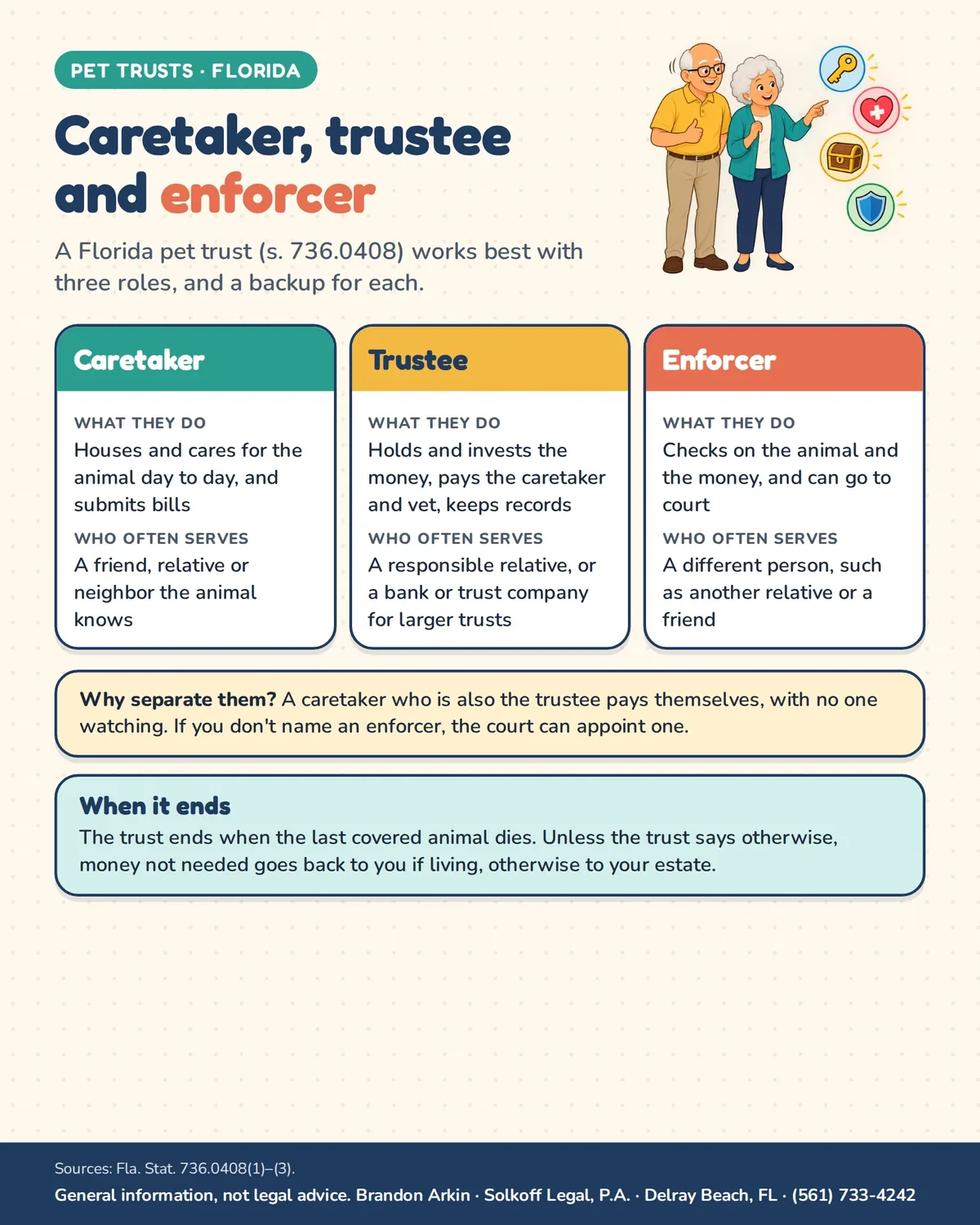
One person can fill more than one role, but separating them builds in a check. A caretaker who is also the trustee pays themselves, with no one watching. If you don't name an enforcer, the court can appoint one, and anyone with an interest in the animal's welfare can ask it to (736.0408(2)). Name backups for each role, since the animal may outlive your first choices.
A trustee owes the duties in the Florida Trust Code, including keeping records and acting in good faith. Our guide to revocable living trusts explains trustee duties more generally.
| Role | What they do | Who often serves |
|---|---|---|
| Caretaker | Houses and cares for the animal day to day, and submits bills | A friend, relative or neighbor the animal knows |
| Trustee | Holds and invests the money, pays the caretaker and vet, keeps records | A responsible relative, or a bank or trust company for larger trusts |
| Enforcer | Checks on the animal and the money, and can go to court | A different person, such as another relative or a friend |
Role
Caretaker
What they do
Houses and cares for the animal day to day, and submits bills
Who often serves
A friend, relative or neighbor the animal knows
Role
Trustee
What they do
Holds and invests the money, pays the caretaker and vet, keeps records
Who often serves
A responsible relative, or a bank or trust company for larger trusts
Role
Enforcer
What they do
Checks on the animal and the money, and can go to court
Who often serves
A different person, such as another relative or a friend
How much to set aside
There's no formula in the statute. The amount should be realistic, because Florida lets a court reduce a trust that holds more than the intended use requires (736.0408(3)). That excess then passes under the trust's terms, or to your estate. An oversized pet trust can also invite a challenge from relatives.
A common approach is to estimate yearly costs, multiply by the animal's likely remaining lifespan, and add a cushion for emergencies and the trustee's costs.
What to put in the trust
Identification. Name, species, breed, description and microchip number, so there's no question which animals are covered. The statute covers animals alive during your lifetime, so describe how pets you acquire later are included. Standard of care. Diet, exercise, vet, medications, grooming, whether the animal may be boarded, and any housing rules (for example, an indoor cat). Payment method. Whether the trustee pays providers directly, reimburses the caretaker from receipts, or pays a set monthly amount, plus how often the caretaker reports. Medical decisions. Who decides about major treatment and end-of-life care, and any wishes you have. A fallback. What happens if no caretaker can serve, such as placement with a named rescue or sanctuary that has agreed in advance. Leftover money. Who receives what's left when the last animal dies, such as a relative, the caretaker, or a charity. If you don't say, it goes to your estate (736.0408(3)).
Where the trust lives: will, revocable trust or standalone
A pet trust can be written into a will, into a revocable trust, or as a separate document. A pet trust inside a will generally can't be funded until probate is opened. A pet trust inside a revocable trust, or a standalone trust funded during life, can usually start paying right away at death, and can cover the animal if you become incapacitated. Our guide to trust funding explains how money gets into a trust.
For incapacity, your durable power of attorney can authorize your agent to pay for pet care. Many families also keep an emergency card in a wallet naming who to call about the animals.
Alternatives to a pet trust
| Option | How it works | Trade-off |
|---|---|---|
| Gift to a caretaker in a will, with a request | Money and the animal go to a friend, with a non-binding wish | Simple, but the request generally isn't enforceable, and the money is the friend's |
| Pet trust (736.0408) | Money held for the animal, with an enforcer | Enforceable and flexible. Takes more setup. |
| Rescue or sanctuary placement | Advance arrangement with an organization, often with a donation | Check its terms, track record and what happens to the animal |
| Instructions only | A letter naming a caretaker, with no money | Better than nothing, but there's no funding or enforcement |
Option
Gift to a caretaker in a will, with a request
How it works
Money and the animal go to a friend, with a non-binding wish
Trade-off
Simple, but the request generally isn't enforceable, and the money is the friend's
Option
Pet trust (736.0408)
How it works
Money held for the animal, with an enforcer
Trade-off
Enforceable and flexible. Takes more setup.
Option
Rescue or sanctuary placement
How it works
Advance arrangement with an organization, often with a donation
Trade-off
Check its terms, track record and what happens to the animal
Option
Instructions only
How it works
A letter naming a caretaker, with no money
Trade-off
Better than nothing, but there's no funding or enforcement
A hypothetical funding estimate
Assume a retiree in Boca Raton has a 6-year-old dog and a 15-year-old parrot. Some parrot species can live for decades, so the parrot may outlive her by many years. These numbers are illustrations, not cost data.
| Line | Dog | Parrot |
|---|---|---|
| Food, routine vet care, grooming or supplies per year | $2,500 | $1,500 |
| Expected remaining years (ask your vet) | 7 | 20 |
| Subtotal | $17,500 | $30,000 |
| Emergency and end-of-life cushion | $5,000 | $5,000 |
| Caretaker payment, if any, and trustee costs | Set by agreement | Set by agreement |
| Starting estimate | About $22,500 plus fees | About $35,000 plus fees |
Line
Food, routine vet care, grooming or supplies per year
Dog
$2,500
Parrot
$1,500
Line
Expected remaining years (ask your vet)
Dog
7
Parrot
20
Line
Subtotal
Dog
$17,500
Parrot
$30,000
Line
Emergency and end-of-life cushion
Dog
$5,000
Parrot
$5,000
Line
Caretaker payment, if any, and trustee costs
Dog
Set by agreement
Parrot
Set by agreement
Line
Starting estimate
Dog
About $22,500 plus fees
Parrot
About $35,000 plus fees
Ask your veterinarian for an estimate of yearly costs and lifespan. Revisit the amount when you add or lose an animal.
Pet care instructions checklist
Complete one for each animal and keep it with your estate plan and with the caretaker.
Tick boxes stay on this device. Nothing is saved or sent.
Common questions
Are pet trusts legal in Florida?
Yes. Florida law allows a trust to be created for the care of an animal alive during the settlor's lifetime (Fla. Stat. 736.0408). The trust ends when the animal dies, or when the last covered animal dies. A person named in the trust, or one appointed by the court, can enforce it. The money may be used only for the animal's care, except to the extent a court finds the trust holds more than needed. A pet trust can be part of a will, part of a revocable trust, or a separate document.
What happens to the money left in a pet trust?
You decide in the trust document. Many people name a relative, the caretaker or an animal charity to receive what's left. If the trust doesn't say, Florida law sends property not needed for the animal's care back to you if you're living, or otherwise to your estate (Fla. Stat. 736.0408(3)). A court can also find that the trust holds more than the animal needs and release the excess under the same rule. That's one reason to keep the funding amount realistic.
Can the caretaker also be the trustee?
Yes, but separating the roles is usually safer. When the caretaker also controls the money, no one else reviews what's spent. Florida lets the trust name a person to enforce it, and if none is named, a court can appoint one, at the request of anyone interested in the animal's welfare (Fla. Stat. 736.0408(2)). A common setup is a friend as caretaker, a relative or bank as trustee, and a third person as enforcer, each with a backup.
How much should I put in a pet trust?
Enough to cover realistic care for the rest of the animal's life, but not much more. Estimate yearly costs for food, routine vet care and supplies, multiply by the expected remaining lifespan your vet suggests, and add a cushion for emergencies and trustee fees. Florida lets a court reduce a pet trust that holds more than the intended use requires (Fla. Stat. 736.0408(3)), and an oversized trust may invite objections from relatives. Long-lived animals, like some parrots and tortoises, need larger amounts.
If your family is facing one of these questions, you can reach Brandon Arkin at Solkoff Legal, P.A. at (561) 733-4242.
Related on this site
Talk through the next step
Bring your questions, a list of accounts and any papers a hospital, nursing home or Medicaid office has sent you. Call the Delray Beach office or request a consultation, and I can look at where things stand and what may come next. A phone call or an email does not by itself create an attorney-client relationship.
Solkoff Legal, P.A. · (561) 733-4242